Immersion in college
From: The Washington Post

November 19, 2019
Information for parents of kids in Mandarin immersion education
From: The Washington Post
ST. GEORGE — The Washington County School District Board of Education honored dozens of Chinese language teachers in a meeting Tuesday evening.
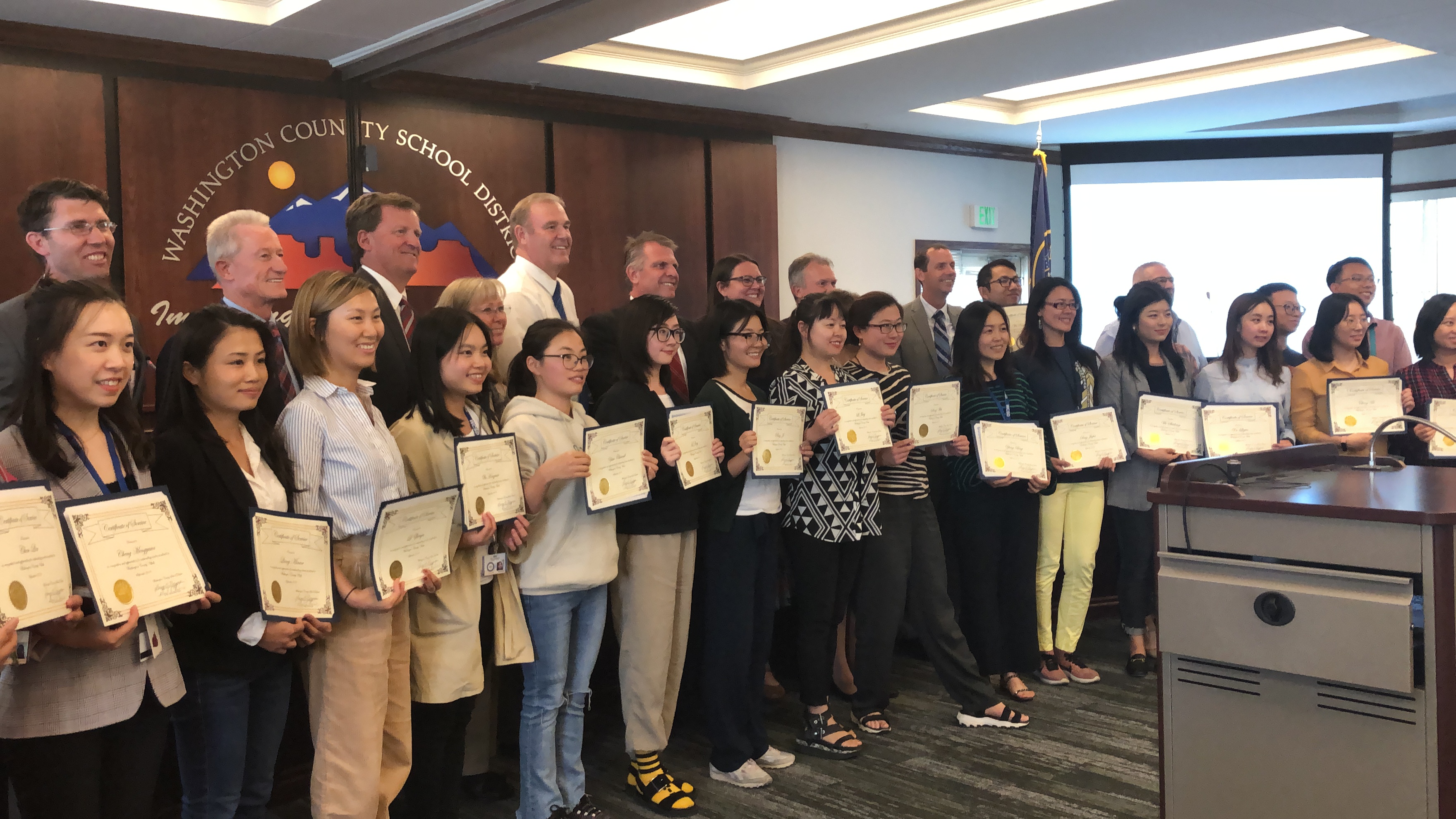
The teachers volunteered their time at local hospitals following a fatal tour bus crash on state Route 12 near Bryce Canyon on Sept. 20. The tour bus was carrying 30 Chinese nationals, and the crash injured 12-15 individuals and killed four.
When Washington County School District heard about the tragedy, Marybeth Fuller, the district’s dual language immersion coordinator, said the teachers responded immediately, offering the victims food, comfort and translation services.
Please read more here.
I know, I know, I sound like a broken record. But really, reading (in any language) is truly the way to cement language. If you read a lot in English, your fundamental grasp of English grammar and style are cemented without memorizing rules that half the time don’t work. You don’t know why, but you know what’s right.
The same thing in Chinese. The more kids read. Or, let’s be honest, if they read at all, the better they get.
I’m focused on this because it was so much my experience. I studied at the University of Lund in Sweden for two years. After my first year there, my Swedish was pretty proficient. But then our teacher told us that as a final project we were going to read a novel. I thought she was insane. But she had a stack of relatively easy-to-read novels to choose from and we all started in. Mine was about the life of an old woman living in a long-term care facility. It was sad (and led me to end up working in a long-term care facility in Lund myself) but also amazing — I could read it! I didn’t look up words (we weren’t supposed to) but just read for meaning. As each chapter got easier and easier, I read more and more. By the end, I was reading it almost as easily as I’d read English.
Mind you, Swedish is written with the Roman alphabet, it’s got a ton of cognates and a pretty easy grammar for someone who speaks a Germanic language like English already. But it really pushed me to an entirely new level in Swedish and I kept reading more books. Even today, more years than I care to think about later, I’m still quite fluent in the language.
So, with that bit of personal history, once again I suggest you introduce your kids to fun to read books in Chinese. And as some push on that, here’s an essay about a Chinese teacher in Iowa who used easy-to-read novels in Chinese to get his students ready for the AP Chinese exam. Of course, immersion students are so much further along than high school students that middle school kids could easily read the books he’s talking about.

I have been teaching Chinese in high school for several years. When I was in college, I started studying Chinese and gained such a love for the language that I went on to obtain a masters degree in Chinese and lived in Guangzhou, China, for a number of years. There are not many of us Americans who teach Chinese, however I think we are able to bring a unique perspective to the classroom.
When I first started teaching Chinese, we mostly followed the textbook. I thought I was doing a good job in covering the content of the textbook, but the only the students who had grown up in Chinese speaking households were the ones passing the test. We steadily worked through the Chinese textbooks and progressed towards more advanced material, yet my student’s ability to understand and produce Chinese in terms of speaking and writing was quite weak.
Please read more here.
 Lynn Berat (second row, center) poses for a picture with her children in front of their Chinese tutor’s house in New Jersey on July 27. Photo: Xinhua
It is not uncommon for non-Chinese to learn Chinese nowadays, as the world’s oldest in-use written language is becoming increasingly popular with the rapid rise of China.
But it is phenomenal that 58-year-old Lynn Berat, who holds two PhDs from Yale University, kind of “forced” her nine daughters to learn Chinese from infancy in a bid to have them well-prepared to be what she called “citizens of the world.”
‘Completely Chinese’
Berat fell in love with Chinese culture when she was giving lectures at Peking University in the early 1980s. She quickly realized that the Chinese language is “pictographic” and “very different” from Indo-European languages.
“It requires a greater effort than a language with an alphabet… Chinese seemed to be something that they [her children] should learn from infancy,” Berat told the Xinhua News Agency in a recent interview.
The article is about French immersion in Louisiana but it contains this interesting tidbit, that there are:
now at least 3,000 such programs in the United States, up from an estimated 2,000 cited in a 2017 study published by the RAND Corporation, and a significant upsurge from about 260 cited by the Department of Education in 2000.
The most common immersion language in the USA is Spanish, followed by Mandarin and then French (though it’s hard to come by numbers.) So interesting that we’re up to as many as 3,000. Of those, about 305 are Mandarin immersion.

This fall, more American students than ever will start their first day of school learning in a language other than English.
From The New York Times
MAMOU, La. — On the first morning of school on the Cajun prairie last week, Alice Renard marched her third graders outdoors and under the sheltering arms of a live oak, speaking to them in a language that used to be beaten out of Louisiana schoolchildren.
Ms. Renard’s Parisian French seemed at once at home and out of place in Cajun country, like the voice of Édith Piaf emanating from a zydeco club. She told her students they had come outside “pour apprendre à travailler ensemble” — to learn to work together — by learning a few new playground games: L’oiseau silencieux, the silent bird. Douaniers et contrebandiers, customs agents and smugglers. Pingouins sur la banquise. Penguins on ice.
Ms. Renard, 27, was one of roughly 65 French-speaking teachers imported by Louisiana this year to help bolster its growing roster of dual-language French immersion schools, part of an international recruitment program that dates to 1972. Most of her students bore Cajun or Creole surnames — Desormeaux, Guillory, Martel, Thibodeaux — and the summer break had rendered their language skills rusty.
Please read more here.
 I have no opinions on Falun Gong myself (so please don’t email about it!). I’m reposting this because every year many Mandarin immersion programs get sent fancy, full-color brochures about the Shen Yun Performing Arts troupe if it’s presenting anywhere near them.
The group performs Chinese classical dance, though the final piece is often somewhat political and focuses on the persecution of Falun Gong members in China (which can make it a little scary for small children.)
I’ve heard people object to Shen Yun’s statement that it is “reviving” Classical Chinese culture, as if it were dead everywhere but in their troupe. But that’s not the issue I wanted to address here.
What I do want to pass along is something that many parents don’t realize — there’s a connection between Falun Gong (a spiritual practice group that’s banned in China) and Shen Yun. That’s important if your program has teachers from China in your schools, as you might be mystified about how those teachers could react to being invited to the performances.
I know one mom who bought two tickets to a performance and gave it to her child’s teacher as a present, but was confused at the teacher’s immediate return of the ticket and mumbled explanation that it wasn’t appropriate. The mom was worried she’d somehow offended the teacher because they’re pricey. But it turned out — after some behind the scenes discussions — that the teacher, who was on a two-year contract through Hanban in China, was worried she’d get in trouble if she attended such a performance.
So a little bit of background might help. I have no idea if it actually has been an issue for teachers from China, as I’ve only heard the one story, but in the interest of passing along information that might be useful, I’ve collected links to various newspaper and magainze stories. I know I myself was initially mystified about what was going on when the issue came up at our school.
Note that if you google “Shun Yun” you’ll find dozens of extremely supportive article from The Epoch Times. Here, too, it’s worth noting that the newspaper is connected with Falun Gong.
Here are some articles that might be useful to those trying to understand the ins and outs of all this:
Please read more here.
—
—
Shen Yun seems like a kitsch dance troupe. But Beijing sees it as the propaganda wing of the Falun Gong movement, and a threat to their rule – and hounds the dancers from city to city, trying to sabotage their shows. By Nicholas Hune-Brown
—
In China the movement sputters on. Abroad its profile grows
 Mandarin Immersion Parents Council