
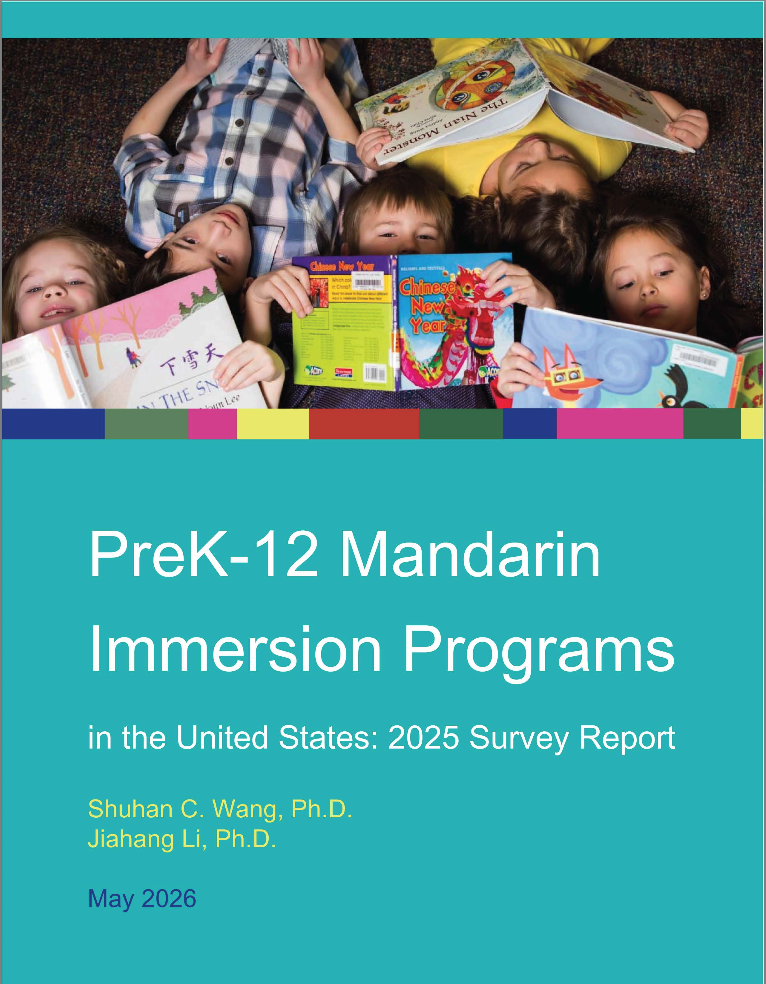
Want to know what’s up with Mandarin immersion programs in the US? Looking for information on how to help your child’s school? Trying to convince your school district to open a new Mandarin immersion program? There’s a new report out for you.
Published this month, it titled, “PreK – 12 Mandarin Immersion Programs in the United States: 2025 Survey Report” and written by Shuhan C. Wang, Ph.D. and Jiahang Li, Ph.D.
It’s a the first big effort from Nexus Mandarin, a new non-profit dedicated to Mandarin language education in Pre-K through college. [Note: I’m on the board]
The authors sent out a survey to Mandarin immersion programs and got 102 responses from 22 states plus Washington, D.C. One of the starting-off points they used for their initial list was the Mandarin Immersion school list here.
Some of the interesting data [Note this is only from the 102 schools that responded, not all MI schools]
- 68% of schools public, 15% charter, 16% private
- 55% strand, 33% stand-alone, 12% strand in a multi-lingual school
- 2011-15 was the Golden Age for Mandarin immersion year starts, 36% of the nation’s schools started during that time.
- 81% of MI programs are in K – 6, 48% in middle school and 20% in high school. (I think that’s a little high for high, probably a result of who answered the survey.]
- Chinese language arts and math are the classes most commonly taught in Mandarin.
- 92% of schools use simplified characters, 6% use traditional and 2% use both.
- Students in MI programs tend to have high academic achievement.
Use Mandarin immersion as a way to sell your school
For parents fighting to keep programs going or to get their school district to start a new one, there’s useful data.
The authors say that “programs should brand MIPs as an innovative alternative to traditional educational programming.” It is a “value-added education with the same amount of funding and effort as for monolingual education.”
Students in Mandarin immersion programs develop the knowledge, skills, grit, and a broader worldview. ”
Not only that, but Mandarin immersion “is value-added education with the same amount of funding and effort as for monolingual education.”
What is Nexus Mandarin?
Nexus Mandarin is meant to fill some of the gap when the Asia Society moved away from focus on Chinese language learning in Kindergarten through high school in the United States. That included shutting down the Chinese Early Language and Immersion Network, which has done a lot of work on immersion programs in the U.S.
The Asia Society did this in part because those programs were funded by the Chinese Ministry of Education and it wanted to get away from any government funding.
Hopefully Nexus Mandarin can take on some of the important work the Asia Society was doing up until 2022.


Leave a Reply