• HOWARD STEPHENSON: Dual language immersion is best of both worlds

    Utah’s dual language immersion program gives elementary students the chance to become fluent in traditional languages as well as critical languages such as Mandarin Chinese. The first schools to begin dual immersion now have fifth-graders in the program.By: Howard Stephenson, Grand Forks Herald

      • image

    DRAPER, Utah — For an additional annual cost of just $33 per student, tens of thousands of Utah students are becoming truly bilingual.

    Throughout the United States, public schools traditionally have focused on teaching foreign languages to middle and high school students. As a result, second language fluency has been, at best, modest.

    Brain researchers have learned that acquiring a second language as an adolescent or adult is significantly more challenging than learning the language as a child because the child’s brain has more language plasticity. Consequently, children pick up a second language more quickly, do not have an English accent in the second language and do not have to mentally translate between English and the second language.

    Please read more here.

  • GREGG ROBERTS and OFELIA WADE: In Utah, foreign language immersion becomes the norm

    It is Utah’s quest to give all students the chance to become linguistically proficient and culturally competent by mainstreaming Dual Language Immersion programs for students of diverse abilities, across all socioeconomic categories and in large and small communities throughout the state.By: Gregg Roberts and Ofelia Wade, Grand Forks Herald

    SALT LAKE CITY — Monolingualism is the illiteracy of the 21st century. On today’s world stage, multilingual skills and cultural competence have taken the lead roles, as the 21st century showcases the emerging professionals of a future competitive global workforce.

    Thus, it is Utah’s quest to give all students the chance to become linguistically proficient and culturally competent by mainstreaming Dual Language Immersion programs for students of diverse abilities, across all socioeconomic categories and in large and small communities throughout the state.

    Utah’s statewide initiative is a lofty, ambitious and unprecedented effort to improve language skills in ways that address the state’s business, government and education needs.

    In 2008, under the leadership of former Gov. Jon Huntsman, then-Lt. Gov. Gary Herbert and State Sen. Howard Stephenson, the Utah Legislature passed Senate Bill 41, providing funding for Dual Language Immersion programs and charging the Utah State Office of Education with creating a world-class immersion program.

    Please read more here.

  • Speaking more than one language may help delay dementia

    Kim Painter, Special for USA TODAY4:02 p.m. EST November 6, 2013

    Speaking more than one language “stimulates your brain all the time,” researcher says.

    The latest evidence that speaking more than one language is a very good thing for our brains comes from a study finding dementia develops years later in bilingual people than in people who speak just one language.

    The study, conducted in India and published Wednesday in the journal Neurology, is not the first to reach this conclusion. But it is the largest and comes with an intriguing new detail: The finding held up even in illiterate people — meaning that the possible effect is not explained by formal education.

    Instead, the researchers say, there’s something special about switching from one language to another in the course of routine communication — something that helps explain why bilingual people in the study developed dementia five years later than other people did. When illiterate people were compared with other illiterate people, those who could speak more than one language developed dementia six years later.

    Please read more here.

  • Meet the Australian children fluent in Mandarin

    By Jon DonnisonBBC News, Melbourne

    Five-year-old Jackie Baldwin can give her name in Mandarin

    Australia’s politicians often talk about the importance of building ties with Asia. Successive governments have promised to increase the number of schools teaching Asian languages, but in fact the number of children in high school learning Asian languages is falling. The BBC’s Jon Donnison has been to one of the country’s few bilingual schools.

    Sitting cross-legged on the floor of her classroom, chewing on the end of her pen, five-year-old Jackie Baldwin is deep in thought.

    Blonde haired, with pink spectacles balanced on the tip of her nose, her hand begins to move steadily and confidently across her page, leaving a neat line of Mandarin Chinese characters.

    Among them I spot the letters “BBC” in the English alphabet.

    Please read more here.

  • Casper school seeks to make students bilingual

    Credit Willow Belden
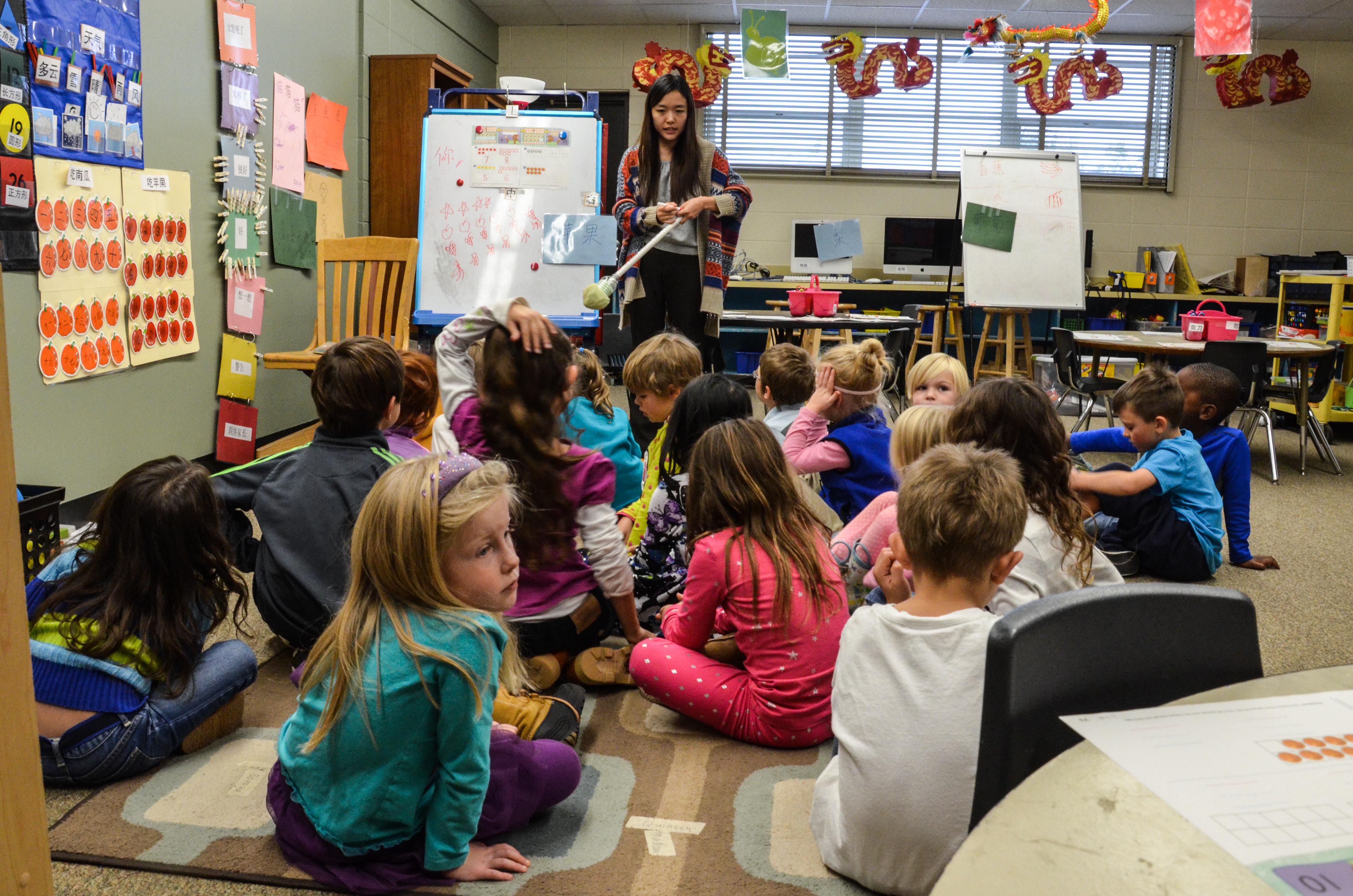
    Kindergarteners in the dual language immersion program at Paradise Valley Elementary School spend half their day learning in Chinese.

    A school in Casper has started teaching some of its classes in Chinese. The idea is that the students in those classes will grow up bilingual. This is the first Chinese immersion program in a Wyoming school, but data from other states that have similar programs show a wide range of benefits. Wyoming Public Radio’s Willow Belden reports.

    Please read and listen here.

  • Global Village Academy's tear-down frenzy
    Global Village Academy’s tear-down frenzy: Global Village Academy’s tear-down frenzyWritten by

    About Global Village Academy

    • It is a tuition-free, language-immersion charter school that teaches French, Mandarin and Spanish.
    • 149 students are enrolled in grades K-4. Intent is to expand each year by one grade, ending at K-8.
    • Students still may enroll for the current year. Those who are interested in learning more about the school may attend informational sessions at 6 p.m. Nov. 12 and Dec. 10 at Dayspring Christian Church, 8005 Highland Meadows Pkwy.
    • Information: (720) 883-6739 orhttp://bit.ly/globalvillagea.
    • Click this article at Coloradoan.com to watch a video of the classroom breakdown and see more photos of classroom activities.

    It’s what Principal Russ Spicer calls “The Great American Breakdown.”

    Sometimes it’s a group, and other times just a couple of people. But several times a week, volunteers transform 10 rooms within Dayspring Christian Church into classrooms, only to revert them into rooms for parishioners hours later.

    “It’s not ideal,” Spicer said, but it’s what the new, state-approved language-immersion charter school has to work with until it finds a permanent home in Fort Collins.

    Three weeks before Global Village planned to open this fall, the city’s planning and zoning board said no to a proposed school site off East Mulberry Street that was in a flood fringe. So Spicer went to leaders at his church, Dayspring, and “they saved us,” allowing the school to temporarily share its space.

    On Wednesday morning, the exterior of the church looked like any church might. Once inside, among chattering students, an educational flair was clear.

    Students wearing shirts emblazoned with the school’s logo danced and sang in French, Mandarin and Spanish — the three languages taught by 12 Global Village Academy teachers hailing from various countries. Some classrooms sported the reds and golds of Chinese culture, others were decorated with posters bearing letters and words the students will learn in their chosen language.

    Please read more here.

  • This is from Judy Shei, whose son is in a Mandarin track school in Singapore and finished second grade in San Francisco’s Starr King Elementary Mandarin immersion program.
    ===
    Just wanted to let you know that we just started tutoring with our son here in Singapore as he’s been struggling a bit in school and I’m afraid just one or two hours a day wasn’t enough to keep up and improve his speaking skills.
    Good news on the fronts… I found out from the tutor that he is in a “higher Chinese” class which progressed more quickly and is more difficult than “normal Chinese.”  From a reading and writing perspective he is constantly telling me that he “hasn’t learned” that character before.  But with the higher expectations, I’ve noticed his reading has improved by leaps and bounds!  So, although the level of reading and writing has been more difficult than what he encountered in 2nd grade at Starr King, he has a strong enough base from the Mandarin program there that making leap hasn’t been insurmountable.
    Also the tutor told me he was really impressed with our son’s listening and speaking ability.  Although he is not on par with a “rice” family (a family who speaks Mandarin at home) Emmett is far ahead of the kids in a typical “potato” family (a family who speaks English at home.)
    With the tutor speaking at normal speed, our son understands about 70-80% and he has no problem expressing basic ideas and communicating, although he does lack vocabulary.  This is entirely due to Starr King, as you know although I occasional speak to my kids in mandarin (maybe 10% of the time) they ALWAYS answer in English.
    Now my worry is that our second child, who starts school next year. Maybe Singapore might not be up to the standards of the San Francisco Unified School District’s Mandarin Immersion program!!!