The short answer is, we don’t really know all the way out to high school. I haven’t seen any national studies looking at how students do when they reach the end of high school.
Anecdotally, motivated students in districts with strong programs seem to do well, but how do students do overall? It’s the perfect project for someone getting a Ph.D. in education (hint hint) but so far I haven’t seen any studies on it.
Which makes this news snippet out of Utah all the more interesting. Parents in St. George (near Zion and Bryce Canon) are upset because too few of their high school are passing the Advanced Placement test for Chinese Language and Culture.
Harmony Vanderhorst, a local parent with three children involved in Chinese immersion classes, said the rate of students passing the 10th grade exams to demonstrate their Chinese fluency was extremely low.”
“The ball has really been dropped with the Chinese program,” Vanderhorst said. “There are some huge gaps that need to be addressed. I think the program has amazing potential, but it definitely needs to be readdressed.”
See the full article from the St. George News here.
I’d be curious to hear how students in your school district do when they get to high school and take the AP exam. Feel free to comment below.
Avenues: The World School, which includes Mandarin and Spanish immersion strands, is opening a California outpost in San Jose. The for-profit school network has schools in New York, São Paulo, Brazil and Shenzhen, China. The San Jose school had planned to open this year but due to COVID-19 will be opening next year instead. It’s already purchased a building in the city and has hired much of its staff. It’s to be called Avenues: Silicon Valley, and the school plans to open in the fall of 2022.
550 Meridian Ave Campus for Avenues World School birds eye view.
SAN JOSE (KPIX) — A New York private school plans to launch a location in San Jose, raising the benchmark for expectations and tuition.
The Avenues, headquartered in New York’s Chelsea neighborhood in Manhattan, has finalized the purchase of 550 Meridian Avenue, a 77-thousand square foot, three-story office building in the midtown area of San Jose, in a $27 million all-cash transaction.
Language Immersion Elementary School Fostering Young Global Ambassadors
By Taylor Bruck Cleveland
March 16, 2021
CLEVELAND — Some native English-speaking children in northeast Ohio have the unique experience of attending school where all their work is in another language, and they absolutely love it.
What You Need To Know
According to the U.S. Census Bureau, in the United States, only about twenty percent of Americans are fluent in two or more languages The Global Ambassadors Language Academy (GALA) in Cleveland is working to increase that percentage GALA is started in 2016 and is currently a K-6 school but will expand with each graduating class until they become a K-8th grade school GALA is currently enrolling students, you can learn more at galacleveland.org
“On my mom’s side, there is my grandma and grandfather that do know Spanish and I want to continue learning so I can speak Spanish better,” said 7-year-old Ilana Little, who attends the Global Ambassadors Language Academy.
The school, also known as GALA, is the only Mandarin immersion school in Ohio, and the first dual language immersion school in northeast Ohio.
I’ve updated my list of Mandarin immersion schools in the United States. We’re now up to 343 schools that are either open now or will open by fall of next year.
Program launched 2018-2019 school year. Has now reached 4th grade.
New York
Pine Street School
Private,K-5
2014-2015
25 Pine St.
Manhattan
New York NY 10005
Also has Spanish immersion track
Utah
Tooele Junior High School, Tooele, Utah
Program reached 7th grade in the 2021-2022 school year.
The program will continue at Tooele High School in the 2024-2025 school year.
Wyoming
CY Middle School
Casper, Wyoming
Program progressed from grade school 2019-2020
CHANGES
E.E. Waddell Language Academy, a K-8 public school in Charlotte, NC, has changed its name to South Academy of International Languages (SAIL)
CLOSURE
Horseshoe Trails Elementary School
At the end of the 2020-2021 school year the Cave Creek Unified School District closed the Mandarin immersion program at Horseshoe Trails, which was founded in 2015. It has just gotten to middle school. More here:
This charter had hoped to open the fall of 2021 but COVID-19 proved too large a hurdle. There’s still some hope it might open for 2022 but unclear at this time.
A care package of moon cakes sent off to a college freshman.
For folks who didn’t grow up in families that celebrated what’s properly called the Mid-Autumn Festival, here’s a little background.
It’s that time of year again, when hockey-puck but delicious cakes appear in shops, students learn poems and people gaze at the moon and think of far-away loved ones.
It’s a traditional celebration held on the 15th day of the 8th lunar month in the Chinese calendar, when the moon is at its fullest and brightest of the year. This year it’s September 21, 2021.
There are many stories about the festival centering on the Goddess of the Moon, Chang’e 嫦娥 and her husband the archer Houyi 后羿, who are only allowed to see each other once every year on the 15th day of the eighth lunar month, when the moon is full.
At it heart, though, the Mid-Autumn Festival is a harvest celebration. Just like at Thanksgiving, families try to be together for the holiday.
There is plenty of symbolism for the holiday that is about the full moon. The moon is round, symbolic of the family coming together. It’s popular to eat a family meal together called tuán yuán fàn 团圆饭 or “reunion dinner.”
If the family can’t all get together, they they all look at the moon and think of those who are not together with them knowing they’re all looking at the same moon.
In China people exchange lyrical text messages talking about how they wish they could be together. You can find some examples here.
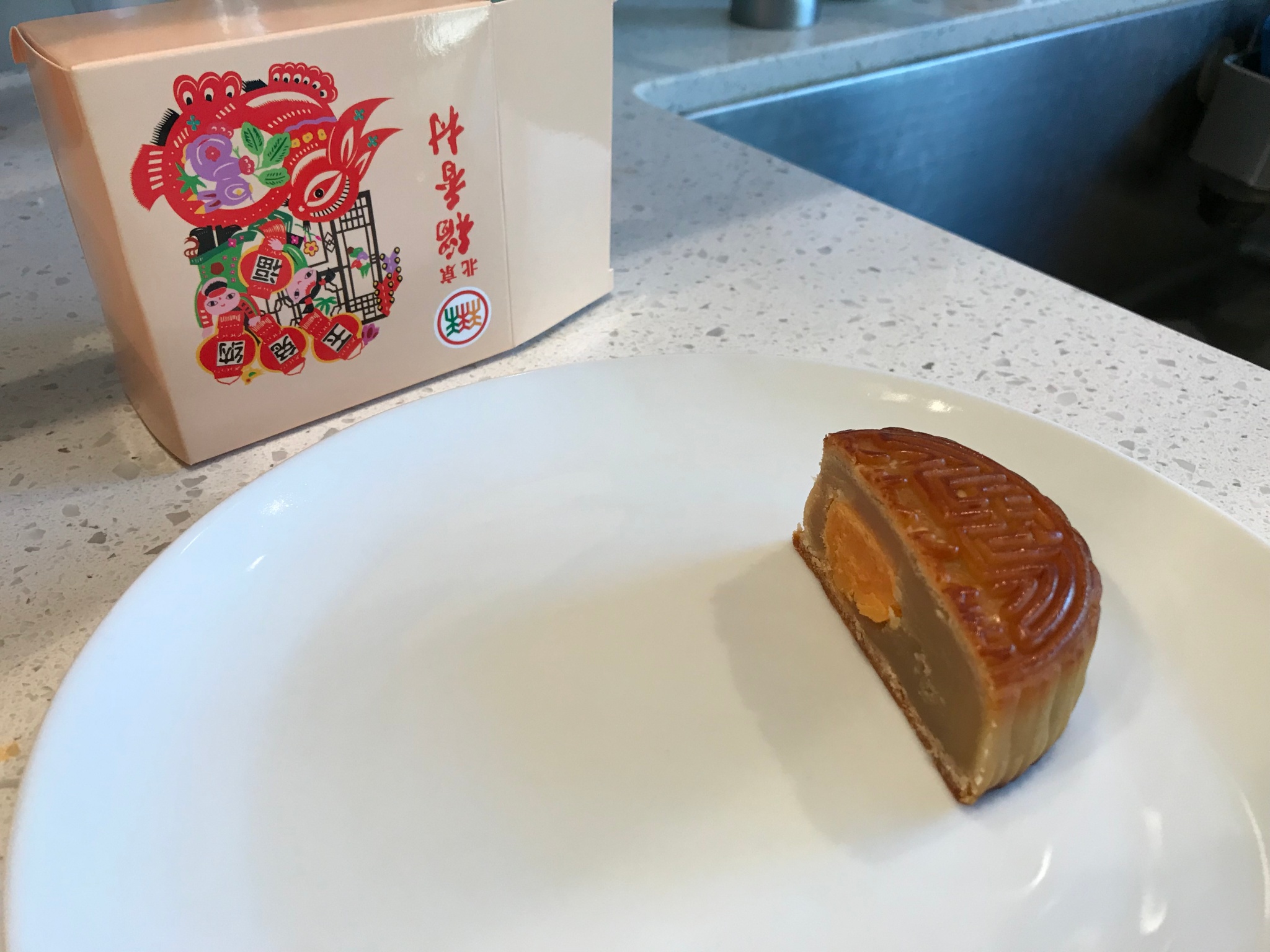
It’s also a time to eat moon cakes. In my family we tend to call it “the festival of moon cakes.” These are dense treats consisting of a thin pastry coating over a disk of (generally) sweet red bean paste or lotus seed paste. Lotus seed paste is very sweet and something like the Chinese equivalent of marzipan.
Inside that sweet filling in many moon cakes is a single, hard-cooked, salted yolk from a duck egg. The saltiness of the yolk contrasts nicely with the sweetness of the filling, or at least it does for me. Some moon cakes feature two yolks, which seems like too much for me but your taste may vary. But perhaps more importantly in a culture enamored of symbolism in food, the egg yolk is thought to look like the full, round moon. Moon cakes are cut into thin wedges and typically served with tea.
Moon cakes have become an important present to give during the weeks around the Moon Festival. Go into any Asian supermarket and you’ll find the front of the store piled high with stacks of different types and price points, depending on the quality and how fancy the packaging is. While sweet red bean paste and lotus seed paste are the most common, you’ll also find nut-filled, pineapple and melon (these are vile, I’m just warning you.) There are also smaller silver dollar-sized moon cakes that are more single serving.
This year we can’t go visit family and friends. But we can send texts, look at the moon and know that they, too, stand under the same moon. We’re all in this together.
And if you’d been wondering how moon cakes are made, here are some cool videos:
Students in the Chinese track at the German International School in Beaverton, Oregon.
The Portland, Oregon area is a hotbed of Mandarin immersion. It’s got the storied Mandarin immersion program in the Portland Public Schools as well as the International School, which offers Spanish, Mandarin and Japanese immersion, Hope Chinese Charter School. Oh, and the German International School.
Die Deutsche Internationale Schule?
Yes, and therein lies a tale.
First, let’s go back to 2008 when the Northwest Chinese Academy (NWCA) opened in Beaverton, a western suburb of Portland. The private school offered Preschool through 5th grade Mandarin immersion and had grown to more than 70 students by 2016 when it purchased a large new space, moving in 2018 from a compact building that had helped form its culture.
In 2018, it also got a new head, Martha Ortiz, a Mandarin-speaker who been the founding head of Wahaha International School, a bilingual international school in Hangzhou, China.
Unfortunately, in the midst of shifting to a new school building and a new head, NWCA began to grapple with lower than expected enrollment numbers for the coming year.
In her second year as Head of School in the fall of 2019, Ortiz began attending meetings where heads of other schools in the Portland area got together to talk and share expertise. At one of these she met Blake Peters, head of the German International School, also located in Beaverton.
In January of 2020, just before COVID-19 hit, Ortiz and Peters had set up visits to each other’s school because they were so close and both focused on language immersion. On her first visit to the German school, Peters showed Ortiz a space that another school had been renting but which would soon be opening up and asked if she knew any schools that might be interested.
“I walked into that space and instantly had this feeling that NWCA would be amazing in this space,” she said.
Remember that NWCA had just moved into a new space. But Ortiz was convinced there was something there. After one of her weekly meetings with the board of the Northwest Chinese School, she said to her board chair, “Can I share a crazy idea with you?” and broached the idea of possibly moving into the German school’s building and renting out the Northwest Chinese School’s space.
During that difficult period, NWCA was crunching numbers and wondering if it could even make the following year happen.
At the same time, Ortiz and board members were also talking about whether it might make sense to merge with GIS. There were discussions between schools, but no decisions were made.
Then COVID-19 hit and everything changed. The school’s upper grades went to an online model and shifted to teaching via Zoom, though preschool and Kindergarten classes were able to stay full time five days a week under an emergency license. Discussions between the two schools ended as both were busy coping with teaching during COVID.
At the end of February 2020, the NWCA board made the heartbreaking decision to close. There was a board meeting for a vote and the next day it was announced to the school community and staff. Ortiz and the board felt it wasn’t fair to families to not tell them as soon as possible, to ensure all students could find good placements for the next year and allow for an orderly shutdown, a painful process for the more than ten-year-old school.
It had been a hard year and an even harder winter. Then, out of the blue, the German International School came back to NWCA in mid-May and said things had stabilized enough that it could at least begin talking about possibilities.
“The commitment wasn’t necessarily to do something but to institute a joint task force, to look at the feasibility and possibilities, and come up with a decision by mid-June,” Ortiz said.
In the midst of the most tumultuous year in the school’s decade-long history, a group from both schools began a series of three extremely intense meetings on Friday afternoons.
“After the second it was ‘Yes, we’re both in.’ By the third week we were pretty certain we were ready to propose it to our families,” said Ortiz.
From preparing to close, the Northwest Chinese Academy now shifted to telling its families, and potential new families, about the three year trial of a potential merger. They led socially-distanced tours, video chats and sent out scads of information.
“It was a truncated timeline — all of this was happening during COVID-19, it was quite remarkable that it all came together,” Ortiz said.
Most of the school’s families made the transition, though some had found other schools in the three months when NWCA was planning on closing.
In some ways, organizing the transition in the midst of a pandemic helped. “It broke some of the constraints that we were operating under, it gave us this sense of it was OK to do things in an unorthodox way. We were all operating on a right-time, right-place mentality,” said Ortiz.
For the two schools it was an opportunity to expand the languages and cultures that each were able to offer to their communities.
During this process, NWCA staff was touched by the generosity of the German International School, said Ortiz.
“It’s a very warm and supportive community. They wanted to provide a home. They saw the grief and the pain the community was going and they were so open-hearted,” she said.
In the fall of 2020, the newly merged schools opened their doors again. All Preschool and Kindergarten classes were full time five days a week while grade school initially met for two hours a week, running mainly through remote learning. That then increased to three days a week for two hours each time, then to half days, and after the spring break, the grade school students returned to school full time.
The school now has about 250 students, 53 in the Chinese Track and 200 in the German track, from the 2-year old-class through fifth grade. The Mandarin preschool class has a waitlist. Next year, the school projects it will continue to grow.
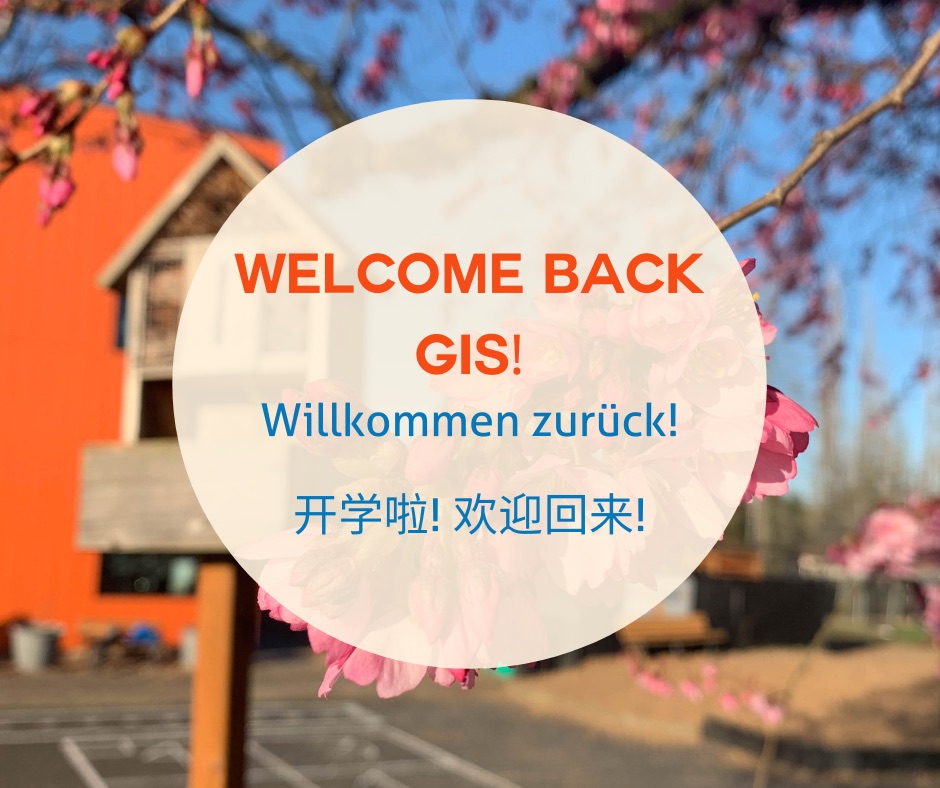
The school continues to be called the German International School, though its opening web page now features the words, “Find out about our new Chinese track.” The options for a new name is scheduled to be discussed in Year 3 according to the 3 Year Plan produced by the joint task force, but “it’s a low priority on the list of things that need to be done,” said Ortiz.
GIS is beginning to meld the partnership into something new and more powerful, offering a German track and a Chinese track, said Ortiz. It is an International Baccalaureate school and the grade school Chinese track is in the midst of a three year transition to full integration of the IB framework, while the Preschool and K levels have been using the IB framework from Day 1.
The school will be truly multicultural. On St. Nikolaus day students were given individual goodie bags, in the German tradition. For the Lunar New Year, students got hong bao (red envelopes) filled with stickers and chocolate coins.
Integrating the two schools is going well, Ortiz said.
“I was out on the afternoon pickup line the other day and saw a 5th grade Chinese track student hanging out with a 5th grade German track student. They were talking and you could tell they were enjoying hanging out together. It’s happening!”
The new school year began on September 8 and everyone is excited for the future.
“We are in the midst of our first integrated New Teacher and Back to School Week that we had the luxury to plan in advance, and the connections and exchanges between all staff in both tracks are inspiring. We can’t wait to see how we grow this year!”
CASPER, Wyo. — 45 fifth grade students at Park and Paradise Valley Elementary Schools in Casper have earned the “Pathway Award” for the Seal of Biliteracy, the Natrona County School District announced Tuesday.
The awards are given for students who have demonstrated excellence in multiple languages. Park offers a “Dual Language Immersion” (DLI) program for students in Spanish and Paradise Valley offers a program in Mandarin Chinese.
The awards were presented during the third annual “Seal of Biliteracy Pathway Award Celebration” on May 27.