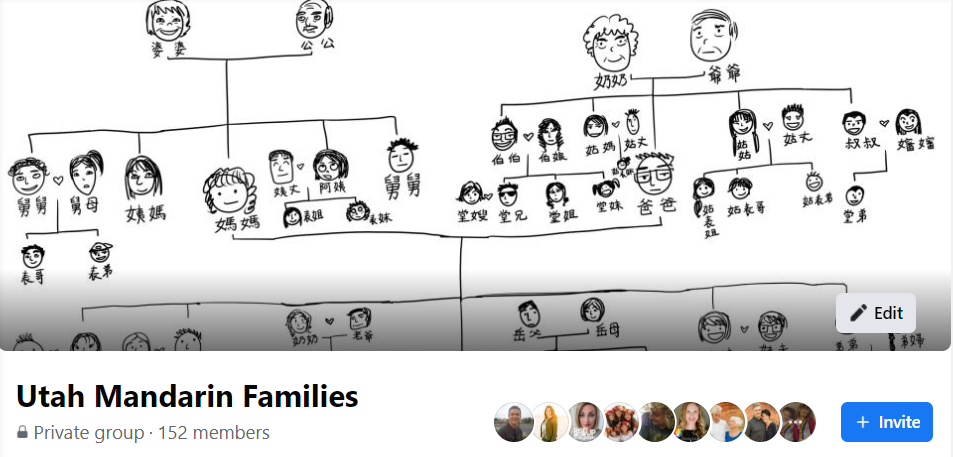
Utah has over 16,000 students in Chinese dual-language immersion programs, and its first cohort of K-12 students is now finishing their senior year in high school. At this critical juncture, Utah parents have formed Utah Mandarin Families, a statewide parent network to support Chinese learning and to brainstorm Chinese-related career paths.
Utah is the only state in the US that administers dual-language immersion at the state-level, so it makes sense for parents to organize at the state level as well. At a time when districts and schools are pulling back on support for trips to China and extracurriculars, UtahMandarin Families aims to function like a “parallel PTA” supporting extracurricular Chinese learning, organizing trips, and exploring China-related internships and careers.
Chinese dual-language immersion programs first launched in Utah in 2009 and are now offered at 33 elementary schools.
Utah Chinese immersion students typically pass the AP Chinese exam in 9th grade, and then move into the Bridge Program, where university-level courses are offered at high schools. Students take 3-credit language classes in grades 10-12, earning up to 9 hours of college credit upon high school graduation.
Utah Mandarin Families aims to:
Providing opportunities to learn and apply Chinese beyond the classroom
Build connections with Chinese people on all levels: personal, family, school, state, educational, cultural, business/career
Help guide the development of the Utah Mandarin Dual Language Immersion (DLI) program
Identify and better leverage China-related partners and resources in education, business and government
Brainstorm China-related college and career paths including study abroad programs, internships, and non-profit opportunities
For more information on Utah Mandarin Families, please reach out to Craig Watts at cragunwatts [at] gmail.com
A nice article about a mom going to Beijing with her Mandarin-immersion educated daughter, pre-pandemic.
The Chinese Lessons
By Jill Bronfman
People told me that my daughter was fluent in Chinese, but before we went to Beijing together I used to have to take their word for it. She had been in a Mandarin immersion program since she was three years old, but since I didn’t speak Mandarin myself, I had to be satisfied with the occasional school speech or compliment from a fellow parent who did speak the language. The opportunity to test this abstract theory of bilingualism in the field presented itself in May when I was asked to speak about the development of artificial intelligence in educational technology in Beijing. I decided to bring my daughter with me as travel companion, translator, and wing woman.
The last time I went to Beijing, I was the same age as my daughter was on this trip, but so much had changed for sixteen-year-old girls, and so much had changed in China. I thought I was worldly, but my world was small. Today, China is a vivid juxtaposition of impenetrable technology and touchable antiquity. Today, a teenager is full of WeChat and snarky memes that she has to explain to me.
A lovely piece by a woman who grew up Mandarin-speaking in the United States, lost her Mandarin and then found it again when she had children. And always nice to have one of my Mandarin immersion articles linked to in the New York Times. Due to the COVID lockdown I haven’t done a 2020 “State of Mandarin Immersion” article, but I’ll try to put one together in the next month or so. I fear we’ve lost some schools but haven’t had time to go through all the links I’ve collected. And I know we’ve added a few, so hopefully we’re still up above 300.
Connecting My Children to Their Heritage in Mandarin
Although my parents’ English is serviceable, it is only in Mandarin that they’re at ease, that they can inhabit their own skins.
New York Times
By Connie Chang
Feb. 12, 2021
On Sunday afternoons, my grandfather would sit by my elbow while I gripped his prized calligraphy brush, tracing inky lines on tissue-thin paper. “Many Chinese consider calligraphy a high form of art,” my grandfather reminded me whenever my attention flagged or arm drooped.
I’d sigh in response — this weekly ritual just felt like more school.
Growing up as a child of first-generation Chinese immigrants, I was used to straddling two worlds — that of my parents and the country they emigrated from, and America, where the pressure to assimilate buffeted us constantly. The message was clear in the media and popular culture of the 1980s: It was better to speak English, exclusively and without an accent; to replace thermoses of dumplings with hamburgers. My father’s college classmate, also a Chinese immigrant, proudly boasted that his kids knew no Mandarin, a claim confirmed when his son butchered the pronunciation of his own name while my parents looked on with unconcealed horror.
My parents, instead, dug in their heels against this powerful wave that threatened to wash out the distinctive features of their past. I spoke no English until I started preschool, but in Mandarin — according to my grandmother — I was a sparkling conversationalist, a Dorothy Parker of the toddler set. The school administrators wrung their hands, worried that I’d fall behind, but my father shrugged, figuring (correctly) that I’d learn English quickly enough.
The Asia Society’s annual conference on Chinese language teaching is April 15-17. It’s virtual this year and thus cheaper and easier to access for teachers. This tends to be where a lot of advances in immersion teaching are introduced and shared, so it’s worth making sure your school’s teachers know about it and can attend. In previous years families often raised funds so teachers could go in person. Less need for that this year, sadly.
2021 National Chinese Language Conference
THE CONCEPT
Join us for a three-day interactive digital experience for Chinese language teachers & education leaders. Throughout the conference, you will HEAR inspiring Plenaries, CONNECT in the Tea x Conversation Video Networking, and ENGAGE in interactive breakout sessions.
The National Chinese Language Conference (NCLC) is more than just a conference. It’s a global community of over 2,800 PK-16 Chinese language teachers and education leaders. At its core, NCLC provides a platform for you to LEARN, ENGAGE, and SUPPORT like-minded educators, as we shape the future of Chinese language education and cultivate multilingual young leaders.
THE DETAILS
Date: April 15-17, 2021 (Thursday-Saturday) Time: April 15 & 16: 6-9 PM EST | April 17: 10 AM-3 PM EST Location: Online, anywhere with a solid Internet connection Ticket Price: Early bird tickets are $80. Regular admission is $100. Purchase your tickets from now until March 1st to take advantage of early bird pricing.
YOUR VIRTUAL TICKET INCLUDES:
3 Thought-provoking plenaries
30+ breakout sessions
Access to teaching resources and on-demand content
Live Q&A with speakers
Interactive roundtable discussions
Tea and Conversation 1:1 video networking with old and new colleagues alike
Live interactions with virtual vendor booths
Exclusive discounts and offers from sponsors
PLUS 14-day access to a replay of NCLC video content, as available: so, if you missed something – we got you covered!
PRE-CONFERENCE WORKSHOPS
We are offering three pre-conference workshops this year and each workshop is only $30.
ACTFL | April 15, 2021, 10 AM—12 PM EST: “Journey to Proficiency: Map the Route, Guide the Tour, Enjoy the Ride” with ACTFL President, Jessica Haxhi
NCSSFL | April 15, 2021, 1—3 PM EST: “Implementing Proficiency-Based Tools & Standards to Build Exemplary K-12 Chinese Programs” with NCSSFL experts, Dr. Ann Marie Gunter and Michele Braud
CELIN | April 16, 2021, 10 AM—12 PM EST: “Developing a Toolbox of Innovative Practices for the Post-COVID Era” with CELIN Director, Dr. Shuhan Wang
Spaces for the pre-conference workshops are limited, so make sure to purchase with your early bird ticket. View more information on the pre-conference workshops here.
THE FEATURES
3 INSPIRING & THOUGHT-PROVOKING PLENARIES. Be inspired by a carefully curated lineup of leading experts and pioneers in Chinese language education. Hear stories of success, struggle and best practices from Chinese language programs and traditional and non-traditional classrooms.
30+ INTERACTIVE BREAKOUT SESSIONS. Engage with pioneering teachers, experts, and peers in interactive breakout sessions across 9 content strands: Assessment | China Across the Curriculum | College and Career Readiness | Curriculum and Instruction | Partnerships and Community Engagement | Program Models and K-16 Articulation | Research | Remote Learning | Teacher Development and Sustainability.
TEA & CONVERSATION NETWORKING. Our Tea x Conversation breaks allow for real-time collaborations and connections. We all sometimes feel isolated as we continue to innovate during the pandemic, these breaks will help us connect with other educators who understand our goals and challenges. Share ideas. Ask questions. And even collaborate virtually.
LIVE NCLC EXPO HALL. Access valuable teaching resources while learning about products & services for your Chinese language classroom and/or program. NCLC vendors will be live in the digital Expo Hall to allow for Q&A, meetings, and demos.
We are also holding a 3-day Digital Scavenger Hunt with prizes and deals from our sponsors that you don’t want to miss!
CONNECT + COLLABORATE. NCLC’s live event chat allows for real connections with other educators. In the chat, you can ask questions, share ideas & resources, and comment on what you’re watching. Looking for a specific person? Search for them in the event attendee list. You can send them a direct message or even have a video meeting- all within NCLC.
EVENT CODE OF CONDUCT. NCLC is committed to being inclusive and providing a safe, friendly, and welcoming environment for ALL people. Please read our CODE OF CONDUCT here.
Why wait? Let’s virtually meet Chinese language teachers and education leaders who are passionate about our community and believe in collaboration and authentic connections!
NCLC IS SUPPORTED BY OUR SPONSORS & PROGRAM ADVISORY COMMITTEE.
American Council on the Teaching of Foreign Languages (ACTFL)
AP® Chinese Language and Culture Development Committee
Chinese Early Language and Immersion Network (CELIN @Asia Society)
Chinese Language Association of Secondary-Elementary Schools (CLASS)
Asia Society is the leading educational organization dedicated to promoting mutual understanding and strengthening partnerships among peoples, leaders, and institutions of Asia and the United States.
TAGSTag:Session Language: ChineseTag:Session Language: EnglishTag:AssessmentTag:China Across the CurriculumTag:College and Career ReadinessTag:Curriculum and InstructionTag:Partnerships and CommunityTag:Program Models and K-16Tag:EngagementTag:ArticulationTag:ResearchTag:Remote LearningTag:Teacher Development and SustainabilityTag:Teacher SwapshopTag:NCLC Explains
Happy year of the Ox. It’s not quite the usual New Year, which includes visiting family, making dumplings, handing out red envelopes or going see a special program at your Mandarin immersion school. But it’s still a happy occasion.
And the glory of Chinese New Year (also known as the Spring Festival) is that it lasts for another eight days, so you’re not behind at all.
You can read about the various usual activities here.
It’s the year of the metal ox, actually, and you can read all about thathere.
For most of China, New Year wouldn’t be New Year without watching the star-studded New Year Special that airs tonight. You can read about it and find it onlinehere.
There are various rhymes for remembering all 12 signs of the Chinese zodiac, ask your child if they know any of them. For reasons I don’t understand, a common one online for memorizing them in English is linked to Red Lobster restaurants.
And a trick if you didn’t grow up in with them — you can usually figure out how old anyone is just by asking what year they were born in. If they’re year of the horse, they were either born in 1966, 1978, 1990 or 2002. I had a friend who once offhandedly said something about how old I was and I asked her how she knew. “You told me your zodiac sign, silly!” she answered.
I’ve been writing this blog since 2007 and though COVID shutdowns have slowed it some point, I have no intention of stopping any time soon.
I do, however, have a rare request. My oldest daughter, a proud Mandarin immersion graduate, is now in her second year of college at Wellesley and is looking for a summer internship in either China or Taiwan. Her spoken Mandarin at this point is good but she’d like to spend the summer in a Mandarin-speaking country. (that’s her in the picture above, on her first day at Starr King Elementary school.)
As she puts it in her cover letter, “My goal with this internship is to experience an international business environment, utilize my Mandarin in an immersive situation and prepare myself to work in Asia upon graduation. I am flexible, hard-working and not afraid to take on low-level jobs and do them with excellence.”
However COVID has shut down a lot of programs that might normally be open so she’s been having trouble finding opportunities. China seems a long shot given COVID travel restrictions so she’s focusing on Taiwan. She’s been working to save money so she can get herself to Asia and pay for housing, so this doesn’t have to be a paid internship.
Just this once, I’m asking those who follow my blog for a favor – if you happen to know of a company that might be interested in having a U.S. college student work for them this summer, she’d love to hear about it. It doesn’t have to be a formal program. She’s been studying economics and international relations and did an internship this winter as a research and analysis intern, but doesn’t have coding skills. (on the list for next year!)
If you know of any opportunities, feel free to email me and I can pass them along to her. I’m weise@well.com.
Thanks and next post we’ll be back to our regularly scheduled programming.
A diorama of a volcano from a Mandarin immersion school student.
While learning a new language can be challenging at any age, studies have shown the earlier a person learns a new language, the easier it will be. Additionally, research shows bilingual people have an easier time with several key brain functions such as reading comprehension, understanding math concepts and using logic.
Whether you’re studying Spanish, French, Mandarin or Arabic, learning a new language can simultaneously enhance the mind in other areas. The following are proven benefits of learning a new language beyond bilingualism that may inspire you to enroll your child in dual language immersion.
1. Increased academic performance
2. Opens up new opportunities
3. Cultivates cultural awareness
4. Improves mental health
5. Enhanced communication & problem solving skills