In general, Mandarin immersion programs do better when they’re in a whole school environment rather than a strand within a school. That said, the Woodstock Elementary Mandarin immersion program is one of the oldest and most popular in the country and families have been moving to the Portland neighborhood for decades to take part, so the move is causing concern among among families.
Portland Public Schools rebalance compels ‘immersion diversion’ from Woodstock School
The Bee
David F. Ashton December 26 2020
When the totally-rebuilt Kellogg Middle School opens at 3330 S.E. 69th Avenue, on Powell Boulevard, in the fall of 2021 – some students, now enrolled in other middle schools in Inner Southeast, will be diverted to make up its student body. That much is clear.
The Portland Public Schools (PPS) administration calls this process “rebalancing” the student load of the schools. Providing input for this process has been a group of parents and administrators that PPS calls their “Southeast Guiding Coalition”. You may have heard about this; it’s been in the news around town. But what you may not have heard about yet is what its effect will be on two celebrated PPS programs in Inner Southeast – programs that people have moved here to participate in. The news is not good.
As part of this rebalance, the Mandarin Dual Language Immersion (MDLI) programs at both Woodstock Elementary School and Hosford Middle School are to be moved, in their entirety, to a different school, about four miles north – quite some distance where those students and their parents live now.
So what happens when immersion kids get to college? Here’s one pathway that’s worth knowing about.
The Language Flagship is a public/private program that is an initiative of the National Security Education Program, whose mission is “to develop a pipeline of foreign language and culture expertise for the U.S. federal government workforce.”
The focus has been on language: Arabic, Chinese, Korean, Farsi (Persian), Portuguese and Russian.
The Flagship sponsors twelve Chinese Flagship Programs at colleges and universities across the U.S.; each offers unique strengths and provides undergraduate students with pathways to professional-level proficiency in Chinese alongside the academic major of their choice.
There’s a nice web page here with videos about several of the programs.
Arizona State University Brigham Young University Hunter College Indiana University San Francisco State University University of Hawaii, Manoa University of Minnesota University of Mississippi University of North Georgia University of Oregon University of Rhode Island University of Washington Western Kentucky University
There’s also a Flagship program for K-12 schools, you can find out more here.
And here’s a release from Western Kentucky University about students who won Critical Language Scholarships and one, Ryan Richardson, who is a member of the school’s Chinese Flagship program.
The Language Flagship is now expanding into African languages, including Akan/Twi, French, Swahili, Wolof and Zulu.
The Flagship program in turn is part of the National Security Education Program. Its history goes back 30 years to 1991 when the David L. Boren National Security Education Act mandated the Secretary of Defense create and sustain a program to award scholarships to U.S. undergraduate students; fellowships to U.S. graduate students; and grants to U.S. institutions of higher education.
NSEP was created to develop a partnership between the national security community and higher education, addressing the national need for experts in critical languages and regions.
It’s not that students who do these programs have to go work for the Army or in intelligence, but to increase the number of high-level speakers overall. The Act was one of the most significant efforts in international education since the 1958 passage of the National Defense Education Act.
Much of the increase in immersion programs at the K- 12 level has come from government funding, America’s investment in making sure we remain a polyglot, globally-connected nation that can talk — and listen — to the rest of the world.
Without people to people connections, we can fall prey to misinformation. Here’s to more cross-cultural conversations in the future!
Centner Academy in Miami has been much in the news of late after reports surfaced that the private school refused to hire anyone who had gotten the COVID-19 vaccine, with the school’s owner falsely claiming being around vaccinated adults might harm children.
That’s quite simply untrue.
Unfortunately, a previous version of the Mandarin immersion school list included Centner Academy as offering a Mandarin immersion program.
When the school first launched in 2020, it took over from the Metropolitan International School, a private school which focused on languages and served many international students.
Earlier versions of the Centner Academy website made it seem as if Mandarin would be integral to the curriculum.
BATESVILLE – The Batesville Community School Corporation (BCSC) is pleased to announce it has been chosen as the 2020 recipient of the Indiana Foreign Language Teachers Association (IFLTA) Wide World Award for Distinguished Dual Language Immersion (DLI) Program, according to BCSC Assistant Superintendent Melissa Burton.
“Our Mandarin dual immersion program is in its fifth year, with our inaugural class now in fourth grade at the Batesville Intermediate School (BIS),” Burton said. “Starting in kindergarten, participants in this program are instructed in both English and in Mandarin, giving them a unique experience not offered at any other public school corporation in our state.”
That increase of just seven schools is the smallest since 2006, though it of course comes in the midst of a global pandemic which has severely interrupted education and causes many school districts to put potential new programs on hold while focusing on re-opening schools to in-person learning.
New schools to the list that either opened in the fall of 2020 or will open next fall include:
CE Academy, a Mandarin immersion charter school opening in the fall of 2021 in Cary, North Carolina.
Science Language and Arts International School, a private K – 8 school in Brooklyn, New York. It has had a French immersion strand since opening in 2011 and added a Mandarin strand in the fall of 2020.
Rondo Elementary School, a new public Mandarin immersion program which will open in Eastvale, California in the fall of 2021.
Irvine International Academy, a K – 6 charter Mandarin immersion school in Irvine, California in Orange county. The founding principal is Steven Chuang, who was previously the principal at College Park Elementary School in San Mateo. College Park is a 14-year-old and highly sought-after Mandarin immersion program in San Mateo, California. The IIA will open in August 2021.
New Lexington School, a Mandarin immersion program in the El Monte City School District in Los Angeles county. It is a strand in the K – 6 school and launched in 2020-2021.
International School of San Antonio, this K – 5 school has long had a French immersion track and is adding a Mandarin strand in the fall of 2021.
Oberlin Magnet Middle School in Raleigh, North Carolina. This public middle school offers the continuation of the Wake County Public School System’s Mandarin immersion program which begins in Stough Elementary School.
Emanuele Elementary School, a public K – 5 school in the New Haven Unified School District in Union City, California which began offering a Mandarin immersion strand in the fall of 2020.
Westdale Middle School in Baton Rouge, Louisiana which launched its program in the fall of 2020 as a continuation of the Mandarin immersion program at Baton Rouge Foreign Language Academic Immersion Magnet.
I fear I have missed some new middle schools that have added Mandarin immersion as their district elementary schools graduate their first classes of fith graders. It can be difficult to find the middle schools because often there’s nothing written about them on the district websites, as parents in the program automatically know where the school feeds to. If you know of one I’ve missed, please tell me.
An update on the Global Ambassadors Language Academy in Cleveland, Ohio. In the fall of 2021 it will be adding a. 6th grade class, the beginning of its middle school! The charter school has been adding a grade level each year since it was founded with Kindergarten and 1st grade in 2016. It will add 7th grade in 2022/23 and 8th grade in 2023/24.
One name change is the Northwest Chinese Academy of Beaverton, Oregon, a Portland suburb. It almost closed but instead (and happily!) merged with the German International School, also in Beaverton. The school now offers a Chinese immersion strand. I’ll have an article about what happened in the coming weeks.
There have also been some schools taken off the list. East Light Academy, a Mandarin immersion charter school in Charleston, South Carolina has closed. And Centner Academy in Miami, Florida was removed because although it originally launched in the fall of 2019 as an immersion program, but instead now offers Mandarin as one of six world languages.
One fun find is Brilliant Star Montessori School on the island of Saipan in the Northern Mariana Islands. A Montessori school that goes through 6th grade, it appears to offer some form of Mandarin immersion, though exactly what type isn’t entirely clear what from their website The school itself was founded in 2000. It’s certainly the only Mandarin program in this U.S. Commonwealth and is located near Guam in the Philippine Sea.
Public schools still make up the vast majority of Mandarin immersion schools, 246 out of 331 that are either open now or will open next fall. Charter schools are 33 and private 53.
In terms of percentages, that’s 74% public, 9% charter and 16% private.
Simplified characters continue to be the most popular form taught, with only 13% of schools teaching traditional. That said, some schools do introduce traditional characters later on so students can read both.
I found another Catholic school that added Mandarin immersion, Saint Michael’s Catholic Academy in Flushing, New York. It launched immersion in 2013 by I only discovered it this year. That brings the total to three: All Souls Catholic School in Los Angeles, Maryknoll School in Honolulu and Saint Michael’s in Flushing.
Overall Mandarin immersion programs generally seem to have weathered the COVID-19 storm. 2021-2022 will be an interesting year. Fewer programs seem to be opening and the long-term reasons aren’t yet clear. I’ll update again next year and we’ll see what has happened.
Maryknoll School in Honolulu has a new president — and she has a long history with the school.
Shana Tong stepped up to serve as the interim head of school after the previous president, Perry Martin, departed this past summer.
Tong’s very familiar with the school — she attended Maryknoll from kindergarten through 12th grade and graduated in 1983.
She also worked as a teacher and principal at the school for 30 years, and was most recently the Vice President of Academic Affairs.
She spoke with Hawai’i Public Radio’s Jason Ubay about school operations during the COVID-19 pandemic, including an update on their Chinese immersion program.
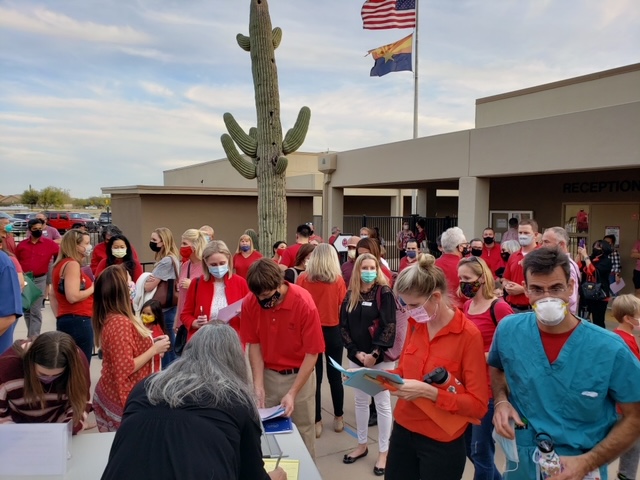
Parents gather at school board meeting to keep their Mandarin immersion program open.
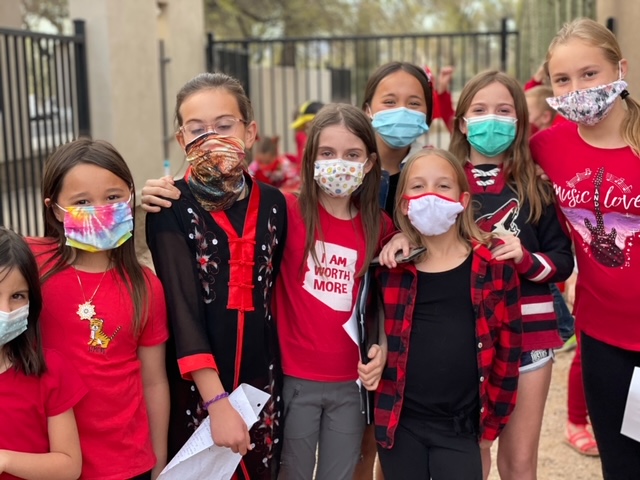
In March, school officials in Phoenix, Arizona notified parents at the Horseshoe Trails Elementary School Mandarin immersion program the popular program would be cut in the 2021-2022 school year.
This came as a shock to parents and they began to work tirelessly to keep the now six-year-old program going. The school district has given various, often changing, reasons for why the program was being axed.
Highly sought-after, there is a wait list and a lottery to get into the program, which was founded in 2014. Its students have consistently been among the highest-performing in the district.
More than 150 parents showed up at a school board meeting to advocate for their children’s school, which in 2020 was named an Exemplary High Performing National Blue Ribbon School, one of 367 in the nation to achieve that honor.
The district’s Spanish and French immersion programs were not cut.
After weeks of discussions, the school board has agreed to work with parents to find a better solution than simply cutting the program.
One issue raised by the district was the difficulty of finding teachers for the program. Please pass along the job posting the program’s current position to those who might be interested.