• From CNA News

    Taipei, May 9 (CNA) India has asked Taiwan for 10,000 Mandarin teachers who could travel to the South Asian country to teach the language, Education Minister Wu Ching-ji said Monday.

    India has recently decided to allow its high schools to offer classes in second languages, including Chinese, and has expressed the hope that Taiwan could help it find teachers of the language. Wu said the Ministry of Education has established an ad hoc group to study the issue and work on plans to recruit and train Mandarin teachers and compile teaching materials.

    At the same time, India will send 2,000 teachers to Taiwan over the next five years to study for master’s or Ph.D. degrees. Wu, who visited India with 13 presidents and vice presidents of Taiwanese universities from April 28 to May 4, said a delegation from India’s Ministry of Human Resource Development will visit Taiwan, probably in October, to further education links between the two countries.

    Read more here

  • From Patch.com

    “Schools such as the proposed Mandarin immersion charters will give our children a foundation for an understanding and appreciation of cultures outside our own. My generation grew up in a relatively insular society. Little emphasis was placed on knowing another culture. Learning a language was offered as an elective for those who cared to know. Today an expansive world view is a matter of necessity for our children. Their opportunities in life will be limited if we allow otherwise. Our public schools will have to take this to heart and soon if our nation hopes to continue to send leaders into the world. Additionally, it is well documented that learning a second language is of great benefit to the cognitive development of young minds, as I’m sure you know. I want a public school system that recognizes this and gives our children every opportunity for success in life.”


    Read the full letter here.

  • Politics – Published Wednesday, 06 July 2011 14:33 | Author: AFP / The Swedish Wire

    Chinese to be taught in all Swedish schools

    • Swedes place 4th in English skills rankingWithin a decade, all Swedish primary schools should offer Chinese lessons, Sweden’s education minister was quoted as saying Wednesday, insisting the move was needed to improve competitiveness.

    “I want to see Sweden become the first country in Europe to introduce instruction in Chinese as a foreign language at all primary and secondary schools,” said Jan Björklund, who heads the Liberal Party, a junior member of the centre-right ruling coalition.

    Getting Swedish pupils to learn Chinese was vital to strengthening Swedish competitiveness, the education minister told financial daily Dagens Industri.

    “Not everyone in the business world speaks English. Very highly qualified activities are leaving Europe to move to China. Chinese will be much more important from an economic point of view than French or Spanish,” he said.

    More here.

  • From the Asia Society newsletter

    The Arts as Inquiry

    Animate Language Learning 

    (Asia Society Museum)(Asia Society Museum)

    By Heather Clydesdale

    When students of Chinese explore art in conjunction with language, they not only have fun, they unravel abstract concepts, deepen cultural understanding, and build language proficiency. There are many ways to enliven lessons, whether by encouraging students to create their own masterpieces, or by helping them investigate and analyze artworks in museums or online collections.

    Kathleen Wang, founder and principal of the Pioneer Valley Chinese Immersion Charter School in Massachusetts advocates infusing the arts throughout the curriculum, explaining, “Many subjects or concepts are so abstract and packed with content that it is difficult for students to retain and effectively use. Students must smell, taste, hear, touch, or see abstract subjects and concepts so that the curriculum is more meaningful and more connected to students personally.”

    Wang and her faculty blend the arts into all subject areas to create what Wang calls “an environment that is full of sensory experiences.” In their K–8 classrooms, language and culture go hand-in-hand through storytelling, poetry, movement, the visual arts, drama, and music.

    HsiuWen Hsieh, a teacher at Pioneer Valley explains, “In my second year at the school, I realized we are not teaching Chinese language. Instead we are using Chinese as a tool to teach our children to understand themselves, and learn about life.” Hsieh describes how the children study botany through art, creating large paper trees with personalized leaves. In other classes, they sing songs, fabricate costumes, craft birthday boards, erect stages for puppet shows, write stories, practice calligraphy, design storybooks, and perform dramatic pieces.

    Read more here.

  • This is about a summer school program, but near the end they say a school in 2012-2013 is possible.

    Camp immerses young students in Chinese language

    By JACKIE BORCHARDT Star-Tribune staff writer | Posted: Sunday, July 24, 2011 1:45 am

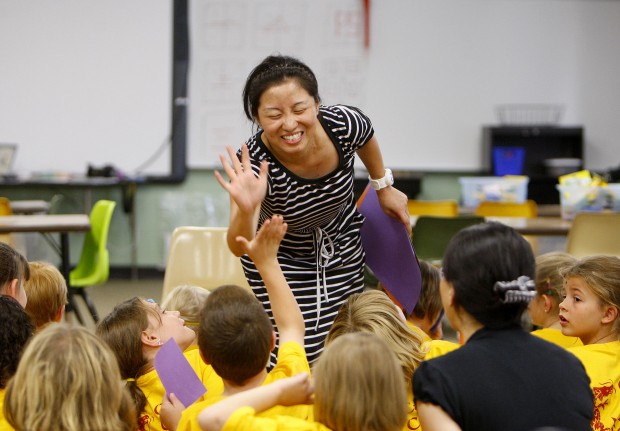
    DAN CEPEDANing Zhao gives a high five to a student during an exercise at a full-immersion Chinese language camp at Park Elementary School in Casper.

    The second-graders circled around squares of colored paper a few inches apart on the floor.

    Each clutched a smaller, colored paper square and leaned forward, waiting for the teacher to name a color and, if it matched his or her own, be the first to touch the corresponding color in the middle.

    The game would be a simple test of speed — if the colors weren’t given in Mandarin Chinese, foreign to the American students eagerly trying to win stickers for being the first to the square.

    Teacher Ning Zhao, originally from China, said the color twice before a few students jumped up and lunged at the papers on the floor.

    “Lán sè,” she repeated. The students, holding green colored pieces of paper, were incorrect.

    Not “lù sè,” Zhao said, “lán sè.”

    A few seconds later, three students realized they held blue (lán sè) papers in their hands and lunged forward.

    Things move fast in the Chinese language immersion program offered this summer through the Natrona County School District. Lessons are planned and taught by native speakers, and class is conducted solely in Chinese — crucial to the structure of the camp, funded through the STARTALK program of the federal Department of Defense.

    Read more: http://trib.com/news/local/casper/article_13d67f7c-680c-54fe-8fb7-88d4d4a02b35.html#ixzz1T8xTQap2

  •  

    From Newsweek.com

    ======

    How to Raise a Global Kid

    Taking Tiger Mom tactics to radical new heights, these parents are packing up the family for a total Far East Immersion.


    china-harvard-c002-millerHappy Rogers was the only American in her graduating class at Nanyang Primary School in Singapore.

    Happy Rogers, age 8, stands among her classmates in the schoolyard at dismissal time, immune, it seems, to the cacophonous din. Her parents and baby sister are waiting outside, but still she lingers, engrossed in conversation. A poised and precocious blonde, Hilton Augusta Parker Rogers, nicknamed Happy, would be at home in the schoolyard of any affluent American suburb or big-city private school. But here, at the elite, bilingual Nanyang Primary School in Singapore, Happy is in the minority, her Dakota Fanning hair shimmering in a sea of darker heads. This is what her parents have traveled halfway around the world for. While her American peers are feasting on the idiocies fed to them by junk TV and summer movies, Happy is navigating her friendships and doing her homework entirely in Mandarin.

    Fluency in Chinese, she says—in English—through mouthfuls of spaghetti bolognese at a Singapore restaurant, “is going to make me better and smarter.”

    Read more here.

  • The Lake Oswego School District will offer two half-day Kindergarten Mandarin Immersion classes in 2011-12, contingent upon hiring qualified staff and on achieving sufficient enrollment to support the program.

    These classes will be located at River Grove Elementary School . Instruction time is 50% in Mandarin and 50% in English. The literacy component of instruction employs the Read Well program, which is the district’s early childhood reading curriculum.

    The Kindergarten Mandarin Immersion Program is a stand-alone program. Enrollment in this program does not guarantee placement in next-level programs that may be added to LOSD offerings. To date, no commitment has been made to continue this program beyond the kindergarten level.

    Enrollment in the Kindergarten Mandarin Immersion Program will be conducted by lottery. Those wishing to participate in the lottery must submit their application to the District Administration Office no later than 3:30 PM on Friday, July 15, 2011. Parents interested in enrolling their students should complete and submit the application form as soon as possible.

    See their post here.