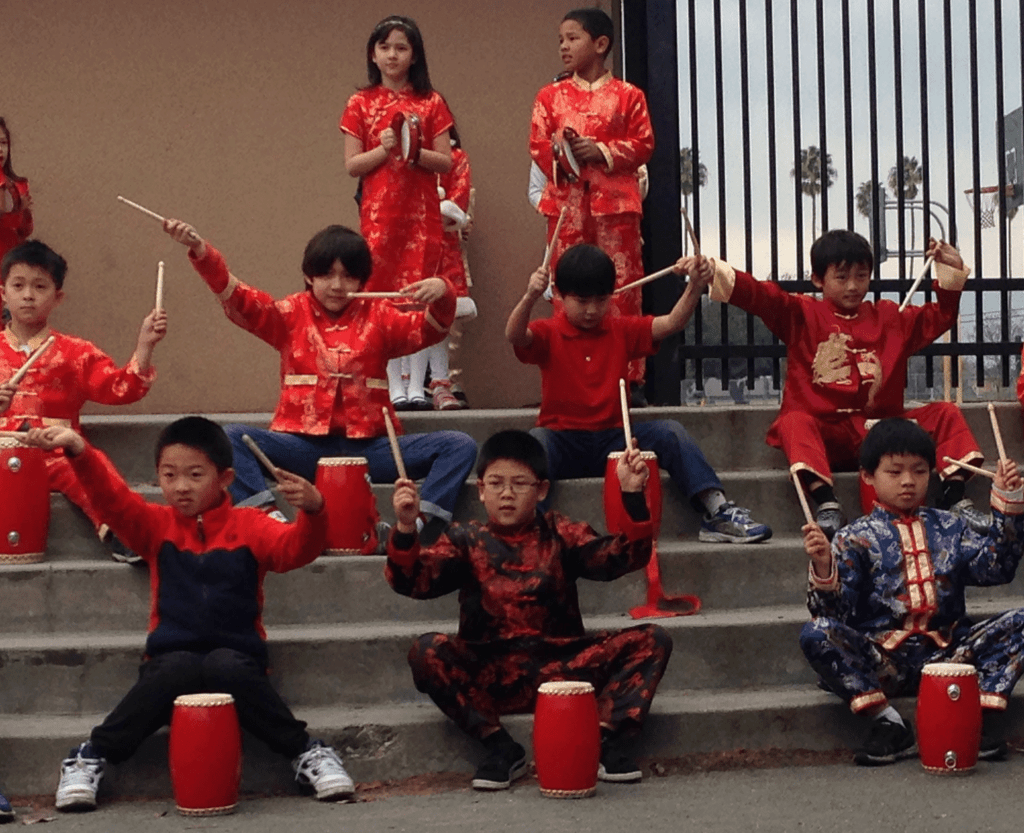
For many years, there were three kinds of immersion schools — public, charter and private. Add parochial to that list.
There are now at least 19 language immersion Catholic schools in the United States, and a network for them has been created at Boston College’s Roche Center for Catholic Education.
On June 22, 2020, President Trump issued a sweeping order that temporarily suspended new work visas and barred tens of thousands of foreign workers from employment in the United States.
The order blocked visas for skilled workers entering the United States under H-1B visas. It will be in place at least until the end of the year.
This type of visa has long been used to hired Mandarin teachers from China to work in Mandarin immersion programs in the United States for two- and three-year stints.
It is an especially large issue in Utah, which uses language teachers from overseas to fill many positions in its extensive, state-wide language immersion program.
Whether the exemption will affect Mandarin teachers outside of Utah whose work visas are suspended isn’t clear.
Utah Superintendent of Education Thanks State’s Congressional Delegation for Help in Getting Dual Immersion Teachers
SALT LAKE CITY – State Superintendent of Public Instruction Sydnee Dickson thanked Utah’s representatives in the Congress, led by John R. Curtis, with assistance from Rob Bishop, Ben McAdams, and Chris Stewart and Senators Mike Lee and Mitt Romney, for their help exempting foreign teachers who will teach in Utah dual language immersion (DLI) schools this fall from President Trump’s June 22 proclamation suspending entry of aliens into the United States. The members of the House delegation wrote as a group to the President seeking a national security exemption on the suspension to allow Utah’s DLI program to continue. Both Utah senators’ offices also pressed for an exemption, which has now been approved. “We are grateful for the bipartisan help from our Representatives in the House and Senate. These international teachers are necessary to keep Utah’s DLI program, which is one of the leading programs in the nation, running at full capacity this school year,” said Superintendent Sydnee Dickson.
“I am thrilled that our concerns were heard and that Dual Language Immersion teachers will be allowed to receive visas this year,” Rep. Curtis said. “This is good policy for our students and all Utahns, and I am proud to have been a strong advocate for this program. International DLI teachers bring valuable diverse experiences and cultures to the classroom and I am glad to see that they will qualify for a national interest exemption from visa restrictions. I will continue to work with the State, the Administration, and my colleagues to ensure these teachers can continue the important work they do in Utah.” “I’m pleased that the State Department has granted these waivers, which will allow Utah’s school districts to obtain cultural exchange visas so their teachers can continue their work during the next school year,” Senator Romney said. “I’m proud to advocate for Utah’s students and will continue working to advocate for our school districts to have access to the resources they need.” Utah schools employ 290 teachers who conduct classroom instruction in French, German, Mandarin Chinese, Portuguese, Russian, and Spanish for roughly 60,000 public school students. Fifty-six of those teachers come to Utah from abroad and require J-1 or H-1B visas to work in Utah. In April, President Trump signed a proclamation that suspended entry into the United States “aliens who present a risk to the U.S. labor market following the Coronavirus outbreak.” Sen. Romney’s office confirmed that U.S. embassies abroad are once again able to issue those visas under a national security exemption to teachers who plan to work in Utah this school year.
More on the order and how it might affect immersion programs
You can think of that two ways — 41% of the state’s students need to learn English. Or, 59% of the state’s students need to get cracking to learn a second language.
As Gregg Roberts, of the American Councils for International Education, says, “Monolingualism is the illiteracy of the 21st century.”
California is coming around to that thinking. In 2018 the state’s Superintendent of Public Instruction launched Global California 2030, with the goal that by 2030, all K–12 students participate in programs leading to proficiency in two or more languages. By 2040, the goal is for three out of four students to be proficient in two or more languages, earning them a State Seal of Biliteracy.
According to the Global California 2030 mission; “By 2030, we want half of all K–12 students to participate in programs leading to proficiency in two or more languages, either through a class, a program, or an experience. By 2040, we want three out of four students to be proficient in two or more languages, earning them a State Seal of Biliteracy.”
Goals include:
By 2030, half of all K–12 students participate in programs leading to proficiency in two or more languages, either through a class, a program, or an experience.
The number of students who receive the State Seal of Biliteracy, which is nationally recognized for college admissions and career opportunities, more than triples from 46,952 in 2017 to more than 150,000 in 2030. By 2040, three out of four graduating seniors earn the Seal of Biliteracy. The Seal is earned by demonstrating proficiency in a language in addition to English.
The number of dual immersion programs that teach languages besides English quadruples from about 400 in 2017 to 1,600 in 2030.
The number of new bilingual teachers authorized in world language classes more than doubles from 2017 to 2030.
The initiative came after state voters’ overwhelming repealed restrictions on bilingual education in California that had been enacted by the notorious Proposition 227 in 1998. It took 18 years, but in 2016 Proposition 58 passed by 73%.
Prop 227 required students be taught in an English-only environment, where the student was taught English by a teacher who only speaks English. English Language Learners who were in separate classes had to be placed in regular classes and bilingual programs were ended.
Immersion programs were in a way a work-around, because they benefited both English-speaking and non-English-speaking students. They were allowed if schools provided abundant information to parents that their children were not being educated entirely in English. Of course, that’s what the parents wanted.
California’s K-12 system is by far the biggest and most diverse in the nation, with 6.2 million students, 40 percent of whom come to school with knowledge and experience in at least two languages.
“Studies have found that speaking two or more languages has many benefits. It strengthens memory and cognitive processes, improves speakers’ ability in their first language, expands cultural knowledge and understanding, builds self-confidence, and even delays the onset of Alzheimer’s and dementia,” state Department of Education officials wrote in the initiative.
Whether the state will achieve its goals, it’s a long way from 1998, when the cry of “English only!” became state law.
My children’s opportunities for work and advanced study have been turbocharged by their ability to speak Mandarin (from California immersion programs) and Spanish (from four years of high school Spanish.) Speaking English is necessary. Speaking one or two languages on top of that is a game-changer.
Austin ISD’s Joslin Elementary School located in south Austin received a $284,000 School Action Fund Grant from the Texas Education Agency to reimagine the school through a new foreign language experience.
Joslin Elementary will be reimaged into a new, city-wide foreign language academy and a new pilot school will be created, using the brand #PilotJoslin. Over the next several years the school will transition to this new program creating a Joslin Foreign Language Elementary School and will be a one-of-a-kind foreign language hybrid in Texas, and the first campus in south Austin to offer these opportunities.
The grant will be used to create a multi-cultural and foreign language experience, giving students exposure to the Chinese culture and Mandarin Chinese while continuing to take their primary courses in English.
Additionally, staff will create a Chinese dual-language immersion program where students use Mandarin Chinese and English throughout their learning experience. This type of program positions students to continue their language learning through high school and become career-ready and/or college-ready in a second language.
For more than two years, Joslin Elementary has been working with the district administration to reinvent the urban school experience. A milestone in this process came this month when the Joslin Campus Advisory Council voted to create this new program on the Joslin Elementary campus.
“This is a “win-win” for current and future Joslin families, and the neighborhoods surrounding Joslin Elementary and throughout the entire city of Austin,” said Joslin’s Principal ChaoLin Chang.
As part of the strategic plan the school will work with partners such the Asian Chamber of Commerce and the Asian Bar Association among others.
“This will be a new school, and a new model with a new principal and our community is extremely happy about this great new opportunity occurring at Joslin with #PilotJoslin iniative, said Joslin Campus Advisory Council member Ryan Turner.
Joslin’s new principal, ChaoLin Chang, is fluent in Mandarin and has a proven record in building a successful Mandarin immersion program from the ground up in Houston.
“With Principal Chang’s background and extensive resources, the Joslin community is in an optimal position to bring a Mandarin foreign language program to Joslin Elementary, said former PTA President Julie Barschow. “Offering different levels of exposure to the foreign language program will allow Joslin to remain positioned to serve its current student population, as well as draw in new students from all over the Austin metropolitan area.
About the TEA grant The Texas Education Agency grant made available by a School Action Fund Grant was given to only two campuses in AISD. The other campus was Travis High School. Grant funds are awarded to school districts to increase the number of students in great schools and are only awarded to school districts that are committed to bold and aggressive action and creating better options for students. Awardees have the potential to be awarded millions of additional dollars through additional TEA grant programs.
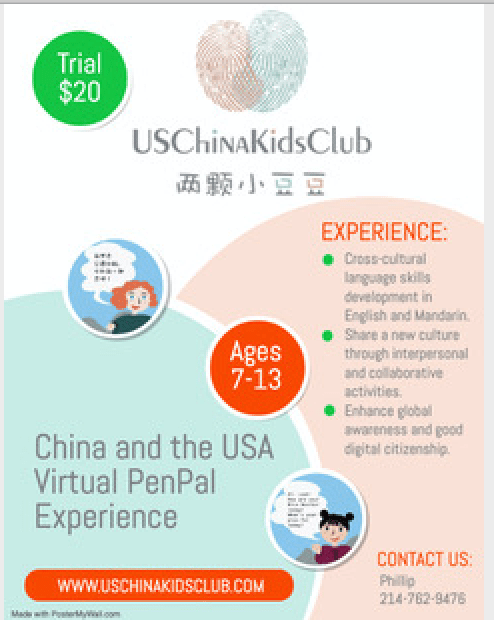
This is an interesting program. It sets up chats between kids in the United States (and elsewhere) and China, half in Mandarin and half in English.
What seems useful about it is that there’s a facilitator, to keep the kids talking. We did some “video pen pal” like tries in our grade school and mostly the kids just giggled and didn’t say much. Having specific topics — “Furnishing my ideal bedroom” for example — helps focus them. And the facilitator makes sure things keep happening.
This might be something for parents looking to give their kids practice speaking Chinese over the summer. They’ve got a handy dandy schedule so you can see when there’s overlap between times kids in China are awake and kids in the U.S. Generally there’s an up to six hour window each day when there’s a good overlap.
I would imagine it’s most useful for kids who have had a few years of immersion, so they can speak Chinese. I haven’t actually tested it and would love to hear from parents who’ve used the service.
The cost is $80 for four 45 minute sessions. There’s a $20 trial so you can get a sense of it.
They have a more structured program for schools, but with COVID-19 they’re finding U.S. parents want to set things up over the summer to keep their kids engaged with Chinese.
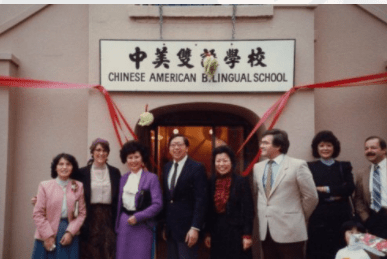
The 1981 opening of the Chinese American Bilingual School in San Francisco, now known as the Chinese American International School. CAIS was the first Mandarin immersion program in the United States.
There will be 327 Mandarin immersion schools in the United States in the fall of 2020. That’s 22 more than last year and a remarkable increase from the 235 of just three years ago.
The increase comes from school districts building out from grade school in to middle and high school, a small but growing group of Catholic Mandarin immersion programs, several new charters and multiple school districts nationwide continuing to implement Mandarin immersion either because parents are asking for it or to fill schools with empty seats.
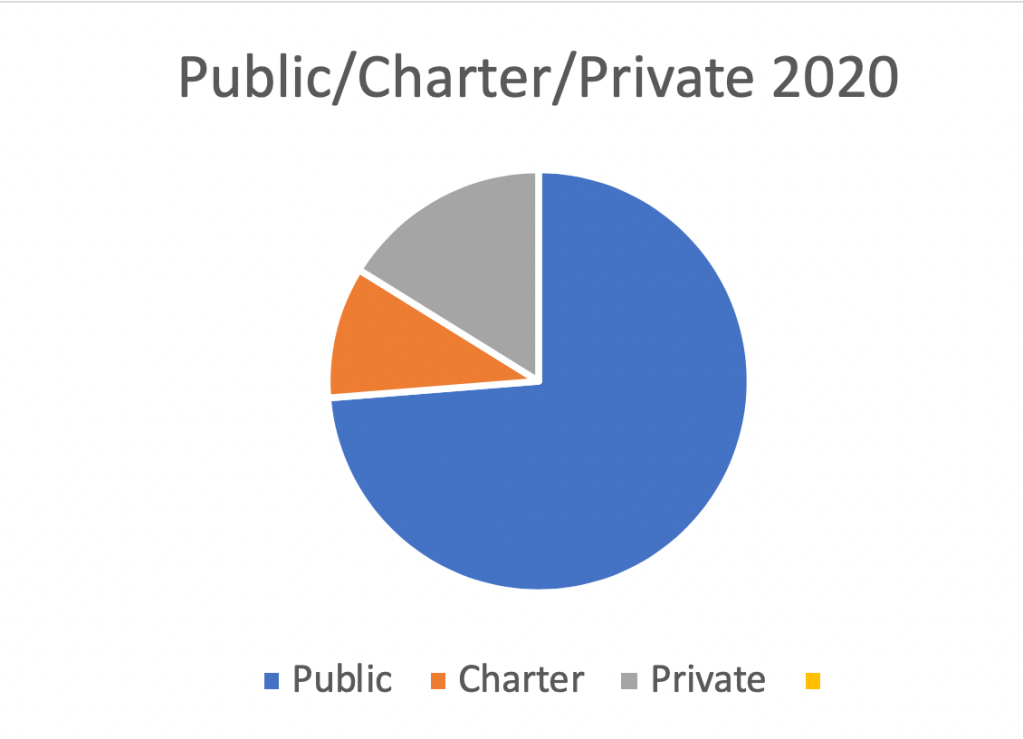
For the 2020-2021 school year, there will be 34 charter schools, 54 private and 239 public.
The vast majority of programs are a strand in a school with other strands, almost always an English-only school program.
The number of schools being added yearly is not increasing at the rate it once did. In the fall of 2018 a total of 34 new Mandarin immersion schools were added nationwide. That’s the largest number ever added in a single year, with only 2012, when 33 were added, also hitting the above 30 mark.
In the fall of 2019 I am aware of 20 schools being added, and another three to come online this coming fall.
There are two caveats to this. The first is that I’m not always aware of new programs or schools being added until later. It’s only when they begin to generate news or pop up on lists of immersion schools or parents or staff at the school contact me that I being to add them. For example, St. Michael’s Catholic Academy in Flushing, NY. Launched a Mandarin immersion program in 2013 but I only found out about this spring when an article appeared in the a local news site.
The second is that given COVID-19 and the extreme financial hardship is it likely to impose upon many districts, it’s unclear whether proposed programs will in fact be launched or not in the coming two years. Time will tell.
New programs
An example of the build-out is Fremont, California, were the first cohort of students reached high school as part of their Mandarin program which began in 2010.
Last year Fremont had 14 Mandarin immersion classes; two each for grades kindergarten through sixth grade at Azevada Elementary School and two seventh and one eighth grade class at Hopkins Jr. High School. There are also 17 students enrolled in the 9th grade at Mission San Jose High School.
In total, about 400 students are in the program. District officials have agreed to add two more Kindergarten classes, meaning that when the program is fully built out K – 12, it could include as many as 1,100 students.
Fifer Middle School in the Caesar Rodney School District is a continuation of the program that began in Simpson Elementary in 2013. The first middle school class,6th grade, began in 2018.
In Baton Rouge, parents have finally gotten a promise from the school distrit that Westdale Middle School will launch its Mandarin immersion program in 2020-2021. This is the continue of the program at Baton Rouge Foreign Language Academic Immersion Magnet, which launched in 2013.
And in Miami, the Centner Academy launched in the fall. It is a private K- 8 school which which began with a preschool and Kindergarten.
Parents in Carey, North Carolina have proposed a new charter school to serve the growing interest in language immersion programs in the Research Triangle Area. The CE Academy: Chinese-English Bilingual Charter School in Carey, NC has a proposed launch date of August of 2021.
There was also one school closure. East Light Academy, a charter school in Charleston, SC, failed to enroll enough students and closed this past year.
Fremont, California is a northern suburb of San Jose with a population of about 240,000, many of whom work in Silicon Valley. The city is 57% Asian.
All of which made it a natural for a Mandarin immersion program in its public schools. In 2008 a group of extremely determined parents made that happen.
Today there are over 400 students in the program with two additional Kindergarten classes being added next year. All due to active parents and a strong parent group — The Chinese Immersion Parents Council of Fremont — that works for the program all through the entire K -12 progression, at the elementary, middle and high school level.
It is so popular that for the for the past few years the wait list for spaces in Kindergarten has been over 50 families, said parent Jeff Bowen.
For the 2019-2020 school year, the MI program in Fremont Unified had 14 classes. There were two each for grades kindergarten through sixth grade at Azevada Elementary School.
Additionally, there are two seventh and one eighth grade class at Hopkins Jr. High School. And the first cohort of students, 17 strong, just finished their freshman year at Mission San Jose High School.
According to survey by the parent group, 73% of the families speak English, 15% speak Mandarin, and 9% speak Cantonese as primary languages at home.
A second grade Mandarin immersion class at Azevada Elementary School in Fremont, California in 2016.
The program is still growing. On Wednesday May 20th 2020, the Council received a vote from the Fremont Unified School District Board that the Mandarin program could add two additional classes for the 2020-21 school year.
When I think back to the beginning before the school board passed the immersion school resolution, I remember how hopeful we were that we could get the program off the ground. I don’t think people know the struggle it was to get the program passed by the school board.
Wei-Lin Tong and her father Dr. Wang worked for two and a half years to get the CIP in front of the school board. Jeff Bowen played a role and stood before the board to argue in favor of the program as well. There were many people at the school board meeting who were against the immersion program citing that the district couldn’t afford the program in the midst of the economic downturn and teacher layoffs.
The board reluctantly put the CIP resolution to vote and the resolution barely passed in June 2010 but with numerous, numerous stipulations. The school board gave us 9 days to recruit 30 students for the kindergarten class, in addition we had to fund the entire start-up cost independently. If we did not meet the conditions, the kinder class would be canceled and then we would have had to start the resolution process again.
Together with Wei-Lin and her parents, we tried everything to get the word out. It was like working at a start-up in a garage. Instead, we met at Asian Pearl restaurant to work out our strategy and it was there that we came up with CIPCF and talked about the direction that we wanted the council to take. It was first suggested that we name the council Fremont Unified Parents’ Council, but we later decided that the acronym, FUCP was too close to a derogatory word.
Jeff and I took the lead in setting up the blog and burned the late night oil creating a business plan and the blog. We worked with Wei-Lin and Dr. Wang on the content. Dr. Wang must have sent us 15 articles a day on the benefits of Chinese immersion to post on the blog. Within a day, Jeff and I got the blog up and running.
As there were only five of us, we knew that we needed to appear legitimate to build CIP. So, we created a logo. Dr. Wang faxed me a sketch of his vision for the logo and I used Powerpoint to create what is now our CIPCF logo. While we worked on going viral, Wei-Lin and her parents got us coverage in the newspapers and worked tirelessly to get the funding. Big contributors were CBC and Dr. Albert Wang. We worked with principal Carole Diamond and the school district to get flyers in the registration packages and organized the first informational meeting. The turnout was incredible; over 100 people attended the meeting. We even had an informal meeting at Fremont Public Library and skyped in the producers of Speaking in Tongues to participate.
In July of 2010, less than a month since passing of the resolution, we had to report back to the school board with our current status. The Board was shocked – as were we – that we had collected enough applications to fill a kindergarten class in the fall.
There were so many missed opportunities by the school board to get the Chinese Immersion Program started earlier. We missed out on a million dollar Federal grant that would have paved the way for us so that we wouldn’t have to worry about fundraising. A Chinese Immersion program in Palo Alto was fortunate enough to be granted the money.
It is truly short of a miracle that we established the Chinese Immersion Program in 9 days, which was two years in the making. Our hope is that the council continues to keep fundraising and outreach a priority to recruit new students. It should be a main focus for CIPCF, as we initially intended when we were sitting at the dinner table with Wei-Lin and her parents.

 Just over