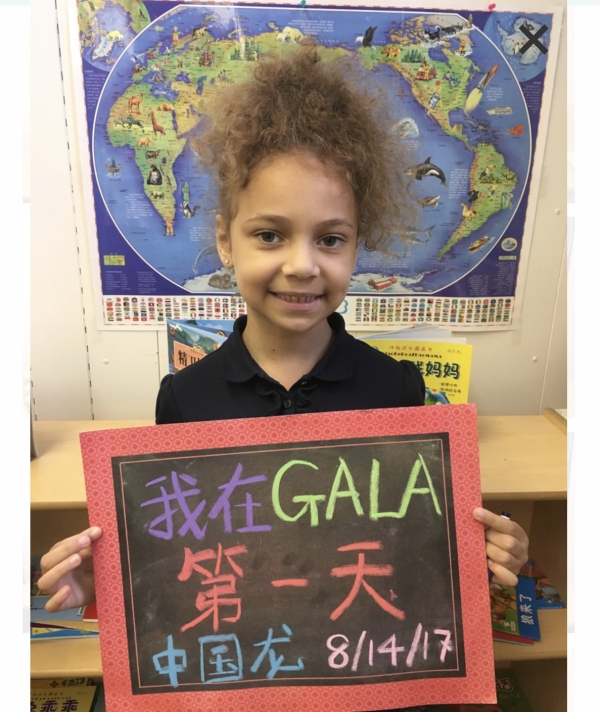
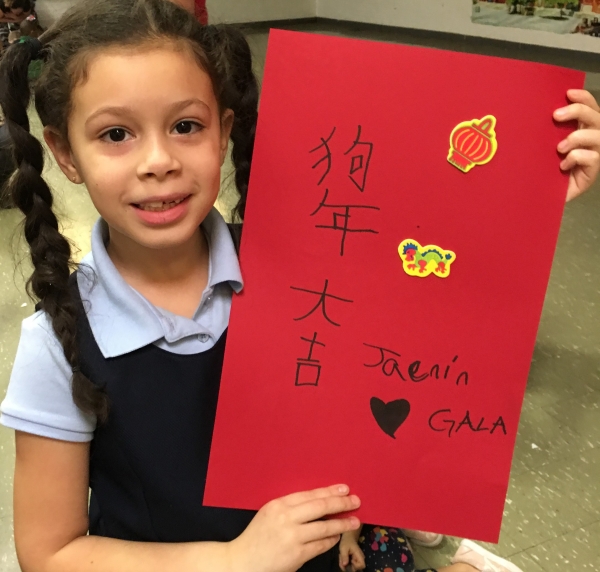
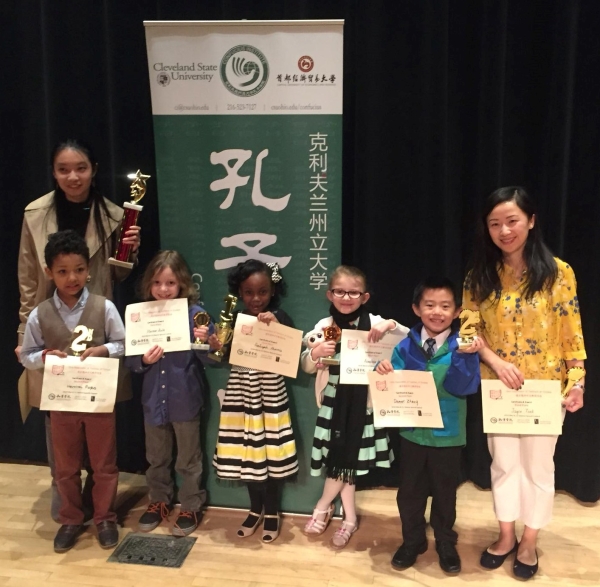
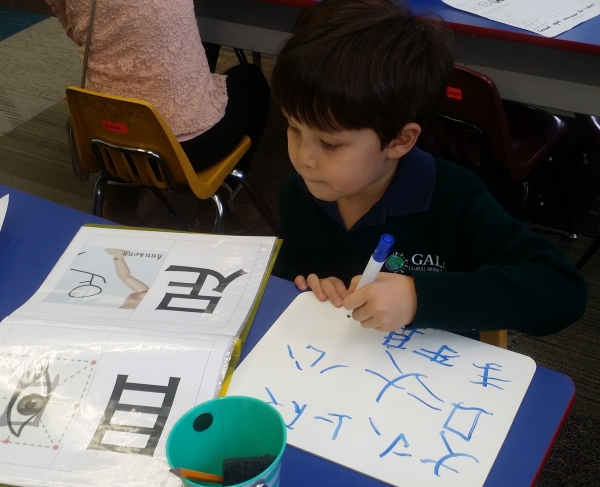
The Global Ambassadors Language Academy (GALA) is a Mandarin and Spanish immersion school on the west-side of Cleveland, Ohio. GALA is the first language immersion school in Northeast Ohio and the only Mandarin immersion school in the state of Ohio.
GALA was founded by Meran Rogers, a parent, educator, and entrepreneur. Rogers’ passion to open GALA was fueled by her experience growing up in a multilingual immigrant household, attending and working in Cleveland public schools, and working as an English immersion teacher in Taiwan. In 2012, GALA established a Board of Directors and 501c3 status. In December 2015, GALA submitted a charter application (Academic, Operation, and Financial Plan) to the Ohio Council for Community Schools and received sponsorship in May 2016.
On August 3, 2016, after nearly 5 years of planning, GALA opened its doors to 60 students in grades K–1. GALA has more than tripled its enrollment, with 200 students in grades K–3 for the 2018–2019 school year, and will continue to add a grade each year, until it reaches K–8 in 2023 (projected to be more than 500 K–8 students).
GALA is an independent, tuition-free, public charter school, which is open to all Ohio residents. No prior language skills are required to enroll. GALA’s innovative model provides students the opportunity to grow up with a bilingual education that will serve them throughout their lives.
Although GALA is located on the west side of Cleveland, in the Jefferson/West Park neighborhood, the school also draws students from across Northeast Ohio: 61% of the students reside in Cleveland, and 39% reside in 26 surrounding suburbs. Staff are proud of the diverse student population: 49% White, 32% Black, 4.8% Asian, 0.5% Native American, and 13.7% Multi-racial. GALA is located in a former Catholic school building, after the school closed in 2012 after 88 years of operation. GALA selected the building after a year-long search and selection process that determined the site to be the best location in Cleveland, based on safety, accessibility, cost, room to grow, and need for a school in the area.
My favorite city in North America (and that’s saying a lot as I come from Seattle) is Vancouver, B.C. Would that I spoke Mandarin, was a teacher and had a work visa.
Given as none of those things are true, I put this out to the universe of Mandarin-speaking teachers who might have (or know people who have) Canadian work visas.
The Mandarin-immersion program in Vancouver B.C. (not to be confused with the one in Vancouver, Washington) is hiring one to three teachers. You can see their job description here.
The only thing I can’t figure out is why, with 43% of the population having Asian heritage, there aren’t more. The closest city to Vancouver in terms of having an Asian population is San Francisco, where we are 33% Asian. And San Francisco has nine public Chinese immersion schools (five Cantonese, four Mandarin) and three private, all Mandarin immersion.
Chinese immersion program to expand to Shue-Medill Middle School
By Brooke Schultz bschultz@chespub.com
Chunyuan Zou teaches a lesson in Chinese to her kindergarten class at Downes Elementary School in 2014. When those students matriculate to middle school in Fall 2019, the Chinese immersion program will expand to Shue-Medill Middle School.
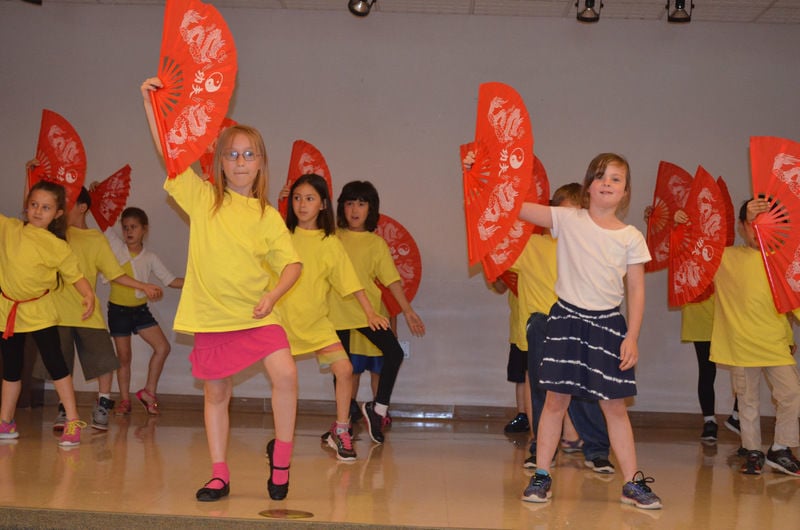
Downes Elementary Chinese immersion students perform a cultural dance at the Newark Senior Center in 2015.
To broaden students’ understanding of culture and the world, Shue-Medill Middle School will offer a Chinese immersion program beginning in the 2019-2020 academic year.
The expansion of Christina School District’s immersion program will come as the district’s first class of immersion students – who started learning Mandarin as kindergarteners at Downes Elementary School – enter middle school.
“Basically, the district started with Downes Elementary School and when they began the program, they tried to look at feeder programs where [students] could go for middle and high school,” said Michele Savage, principal of Shue-Medill. “The district approached me first and I got to be a part of the curriculum development. It’s nice; I had all these years of preparation to get ready.”
By Karen D. Thompson, Assistant Professor of Education, Oregon State University
and Michael J Kiefer, Associate Professor of Literacy Education, New York University
Between 2003 to 2015, multilingual students showed two to three times more progress in reading and math than students who speak English only. With this progress, the achievement gaps between multilingual students and their peers have narrowed substantially.
Our findings not only show that multilingual students are learning more now than in the past, but they also suggest to us that schools and districts are serving these students more effectively.
You turn the page. A picture is off to the side as you stare at rows of pinyin. But that’s not all… there is something below the pinyin. You squint your eyes and there it is: a row of Chinese characters. At first glance, you know a lot of these. In fact, at the beginning, you don’t see a single character you don’t know. But you’re not so certain because you’re distracted; it’s that pinyin! It’s got a tractor beam lock on your eyeballs and just like the Millennium Falcon, you can’t get away. Sweat starts to bead on your forehead as you exert every ounce of will to try and focus on the characters, but you are already within the gravitational pull of the pinyin as it crushes every ounce of desire to read characters.
This, albeit dramatized, scenario is what our children commonly experience when given passages, articles, or books to read in Chinese. It’s so common to see pinyin over all of the characters that we rarely take pause to think about why it is this way and how this became the norm.
Why Books Have Pinyin Over Characters
When Chinese children begin learning characters in school, they already speak Chinese. In the 1stgrade, Chinese characters are introduced to students as characters that represent words they already know and can speak. At the same time, “radicals” or 部首 (bù shǒu), are introduced and meanings of the individual components of a character are explained. New characters are introduced daily, along with short reading texts or 课文(kèwén). At this early stage, characters are learned via rote memorization and pinyin is not even introduced to the children. Some children are still learning their ABC’s (for pinyin as well as for English).
Daily homework includes practice writing of characters taught that day, often with additional characters assigned by the teacher. Termed as 默写(mòxiě) or “writing from memory,” rows of practice characters will be written into small notebooks used specially for writing characters. The next day in class, students are usually quizzed on the characters practiced the night before in 听写 (tīngxiě) where the teacher reads the characters and the students write each one in a booklet.
Show these to your Chinese friends to bring about traumatic childhood memories.
The first semester of 1stgrade focuses on learning these building blocks of Chinese characters. They will finish the first semester with having been taught about 250 characters. Towards the end of the first semester, students begin to learn pinyin. By the second semester of the first year, the kids learn more pinyin, and when one of the reading texts for a chapter uses a character that has not been taught, pinyin is put over that character to help the reader. At the beginning, maybe 2-3 characters in the entire text will have pinyin over them.
Students already know how to say these words in Chinese and now they are learning the characters
Notice the absence of pinyin
By the end of the first year, the children have been taught over 600 characters and have a solid foundation in pinyin. They learned to read characters first and pinyin second.
When 2ndgrade begins, all of the reading texts have pinyin above the characters. This is a great help because at this point characters are introduced more rapidly and it is easy to forget a character that was taught some time ago. It is provided as a reference to the readers in case they don’t remember how to pronounce the characters.
Please enjoy 《太阳的话》(Tàiyáng de Huà) from a 2nd grade text book. Click for a larger image.
Following this process, pinyin over the characters works very well because the students have learned how to read and build a solid foundation in characters before they even began to understand pinyin or English. Characters are much more natural to read than pinyin, and they don’t carry the same rich meaning that characters do, and therefore it’s easy to ignore pinyin when it’s over a sentence.
This learning process works very well for native Chinese speakers and it is highly effective. I have experienced this firsthand, as two of my children attended a local Chinese elementary school in Shanghai.
The English Experience
For those of us for whom our native tongue uses the alphabet, by the time we are in 1stgrade, we’ve mastered our ABC’s, been introduced to phonics, and have begun to read simple words and sentences. Words that use the alphabet are simple and natural to us. I sometimes joke that Chinese characters look like spooky animals to a new learner, but it’s not too far from the truth. If you don’t know the character, you just don’t know it. You cannot phonetically sound it out, but you can do that with English words if you know the phonics.
The Crippling Crutch
This is the learner’s conflict commonly found in Chinese textbooks and reading materials: pinyin written above the characters. The alphabet-loving-eyes are naturally pulled away from the characters towards the pinyin. After all, it’s an order of magnitude easier to read than characters, even if we knowthe characters! Even if the reader covers up the pinyin, he inevitably uncovers it to “check” or confirm what he read is correct.
If you were able to not look at the pinyin then, congratulations! You either 1) are a native Chinese reader or 2) had to exert significant focus.
So what’s the big deal? The problem is that this creates an over-reliance on pinyin and actually slows down the learner’s path to building speed of character recognition, reading speed, and fluency. This is how it works.
A key component of reading fluency is reading speed
Reading speed builds as the reader becomes more familiar with the characters
The more encounters the reader has with a character, the more she will build the speed of recognition of that character.
Pinyin over the characters distracts the reader from the characters.
Pinyin over the characters creates over-reliance on the pinyin.
Because the reader spends time reading both the pinyin and the characters, the overall reading pace slows down.
Because the reading speed is slower…
The reader reads fewer characters
The reader still has time to translate inside her head
Progress towards fluency slows down
It is also for these same reasons that I am not a big fan of the “click your way to fluency” concept which many apps and software enable by clicking or hovering over a character for an instant pinyin and translation. They have their place and use for sure, but utilizing these aids to “read” a text does little for your progress towards fluency (mainly because you are understanding the text in English as opposed to understanding it in Chinese).
This also goes for all those books with Chinese on one side of the page and English on the other. Guess which page the kids read? I guarantee you it’s not the Chinese one. Don’t even waste your money on them.
Some may be saying, “but without the pinyin, I can’t read this Chinese text at all!” If you need pinyin over the text to read it, then you’re not reading at the right level, and you’re not learning the words you’re reading. Put it away and find something easier (if you can) and I’ll kindly redirect you back to a previous blog article about reading at the right level.
For all of you publishers and teachers out there, please do not put pinyin over text that is intended for CSL (Chinese Second Language) students. If you have to use it, only put it over the characters that the reader is not intended to know. We know this takes work and is harder to do, but this is what it takes to put the learner first! And for pete’s sake, don’t tell us just not to look at it. It’s about as effective as this button.
Pinyin is a crutch and sometimes we need a crutch to lean on. Without it our learning-lives would be much more difficult. My hope is that we not create an over-reliance on pinyin and help learners walk on their quest to fluency.
The Mandarin Companion is a publishing house based in Shanghai that features easy-to-read novels in Chinese for those learning Chinese. They focus on rewriting great literature, such as Emma, The Prince and the Pauper or Journey to the Center of the Earth. The books are fun and readable for most immersion kids by the time they get to late middle school.
Note that the Mandarin program isn’t closing, but the school where it’s been housed since it first opened in 1996, is being demolished and will be rebuilt. The current Potomac Elementary School building opened in 1927.
In July the school’s programs will move to Radnor Holding Facility in Bethesda for the duration of construction on the new school. The expected date of return to the River Road campus is January 2020.
Reliving Memories Before School Closes in Potomac
Potomac Elementary alumni share their school days.
By Peggy McEwan/The Almanac
Former students of Potomac Elementary School were invited to the school Thursday morning, April 12, to take one last look at the school, meet old friends and relive memories before the building is demolished this summer.
#“It was fantastic, it turned out better than we anticipated, people were showing up with boxes of photos and mementos,” said Greg Barton, principal intern.
#Sisters Suzy Potter Linger, who now lives in Ohio, and Carolyn Potter Summerville, of Bethesda, were among the first to arrive.
#Both had fond memories of the school and mentioned that their father and uncle both attended Potomac Elementary in the 1920s when the school was located at the corner of Norton and Falls roads.
A side note: This blog depends to a great extent on the reporting done by local newspapers across the nation, which tell the stories of their communities, schools and issues better than any other source. That’s one reason I always link to the stories rather than posting whole – it’s not only the right thing to do, but also insures they get the ad revenue that supports their work.
After the horrific shooting at The Capital Gazette in Maryland last week, let me take this moment to urge you to subscribe, in print if you can, to your local newspaper. Support the journalists who make tiny salaries finding out what’s happening in your town and making sure that nothing is hidden and things don’t happen behind closed doors.
Even if you don’t read it every day, it’s worth it. Our children are likely the last generation that will grow up with printed newspapers – get them into the news-reading habit now. Don’t let them be like the high school student I recently met who, seeing the stack of newspapers in front of me, said “Wow, I don’t think I’ve ever actually held a printed newspaper before. I just read everything on Instagram.”
By REBECCA MULLEN For the Daily Hampshire Gazette
Saturday, June 02, 2018
HADLEY — “I don’t think it’s hyperbolic to say that you are all extraordinary,” faculty speaker Bruce Rubin said in his address to the Pioneer Valley Chinese Immersion Charter School’s Class of 2018.
Of the 11 graduates, 10 were International Baccalaureate Diploma Candidates, four were National Honor Society members and all will go on to pursue higher education.
The Class of 2018 was the second class to graduate from PVCICS, a K-12 charter school which opened in the fall 2007. Classes are taught in both English and Mandarin. The graduation was held Friday evening in the school’s gymnasium.
Rubin’s speech highlighted the ways the students had pushed the envelope over the course of their education.
“You are not afraid to challenge orthodoxy and authority,” Rubin said to the class. “‘Just because’ is not a response that you are willing to accept.”















 Mandarin Immersion Parents Council